Chemistry
Electrolysis of water (Hofmann voltameter)
Electrochemistry · Electrolysis
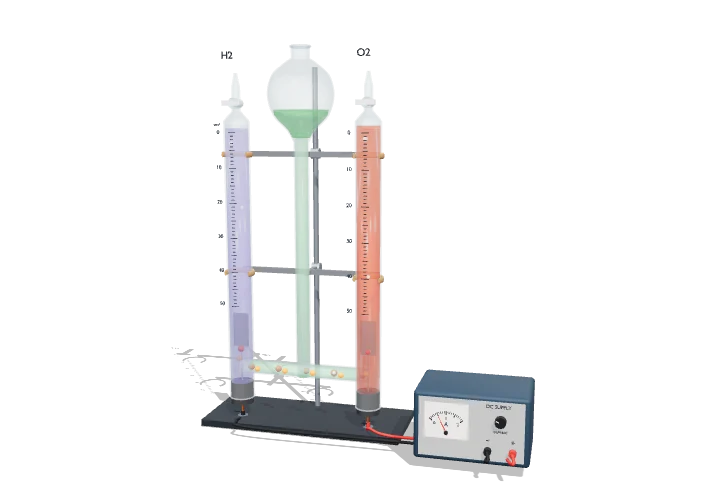 Open the interactive 3D model →
Can electricity really pull water apart into two different gases?
Water is made of hydrogen and oxygen, held together tightly. Push enough electric current through it and you can split it: hydrogen bubbles up at one metal plate and oxygen at the other. You always get twice as much hydrogen as oxygen — the same 2-to-1 ratio as in H₂O.
A direct current forces water to decompose into hydrogen at the cathode and oxygen at the anode, a non-spontaneous reaction that needs at least 1.23 V. Faraday’s laws connect the charge passed to the amount of each gas, which is why a Hofmann voltameter collects exactly twice as much hydrogen as oxygen.
Key facts
- Overall reaction
- 2H₂O(l) → 2H₂(g) + O₂(g)
- Reversible cell voltage (25 °C)
- 1.23 V
- Thermoneutral voltage
- 1.48 V
- Gas volume ratio H₂ : O₂
- 2 : 1
- Faraday constant
- 96 485 C mol⁻¹
- Molar gas volume (25 °C, 1 atm)
- 24.5 L mol⁻¹
Parts you can explore (13)
- Hofmann voltameter
- Stopcocks
- Platinum cathode (−)
- Platinum anode (+)
- Electrolyte
- Hydrogen gas (H₂)
- Oxygen gas (O₂)
- Gas bubbles
- H⁺ ions
- OH⁻ ions
- DC power supply
- Connecting leads
- Retort stand
In the 3D model
Rotate and take apart the model, follow a guided tour of what each part does and why it’s needed, change it with a live slider, and test yourself with a short quiz. Free, no sign-up.
Open Electrolysis of water (Hofmann voltameter) in 3D →
OpenArc Models’ models are simplified teaching schematics. Terms · Privacy