Power & energy
Electrical grid
Power systems · Transmission and distribution
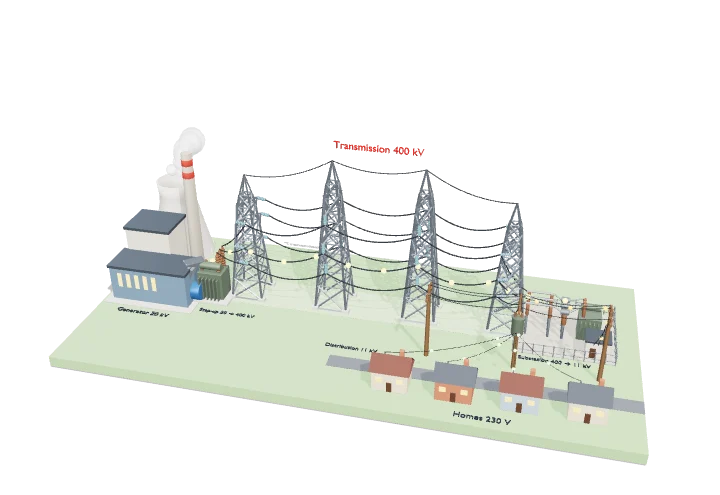 Open the interactive 3D model →
Why do power lines run at 400,000 volts when your home only uses 230?
Power stations are often far from the homes that use their electricity, so it has to travel along wires for many kilometres. Pushing a big current through long wires wastes energy as heat, so transformers raise the voltage very high to send the same power with a much smaller current. Near your home, more transformers bring the voltage back down to a safe level.
The electrical grid moves energy from power stations to consumers by stepping alternating voltage up for long-distance transmission and down again for safe use. Because resistive loss scales with the square of the current, transmitting at hundreds of kilovolts lets a line carry gigawatts with only a few per cent lost as heat.
Key facts
- Generator voltage
- ≈ 11–25 kV (three-phase)
- Transmission voltage
- ≈ 132–400 kV in Europe; 345–765 kV in North America
- Distribution voltage
- ≈ 11–33 kV (Europe); ≈ 4–35 kV (North America)
- Household supply
- 230 V, 50 Hz (Europe); 120/240 V, 60 Hz (North America)
- Typical T&D losses
- ≈ 5–8% of electricity generated
- Large transformer efficiency
- ≈ 99.5%
Parts you can explore (11)
- Generating station
- Step-up transformer
- Transmission towers
- High-voltage lines
- Substation
- Distribution lines
- Distribution transformer
- Homes
- Power flow
- Voltage labels
- Ground and right-of-way
In the 3D model
Rotate and take apart the model, follow a guided tour of what each part does and why it’s needed, change it with a live slider, and test yourself with a short quiz. Free, no sign-up.
OpenArc Models’ models are simplified teaching schematics. Terms · Privacy