Electromagnetism & electronics
Electric guitar pickup
Electromagnetism · Induction
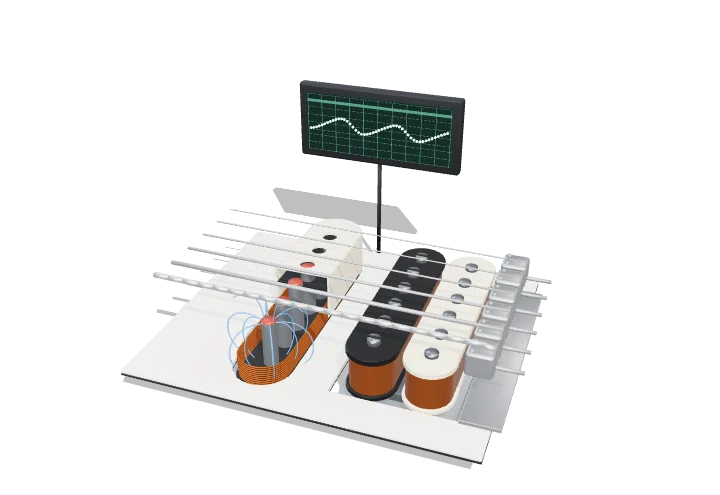 Open the interactive 3D model →
How does an electric guitar “hear” its strings when there is no microphone inside?
Under each steel string of an electric guitar sits a small magnet wrapped in thousands of turns of very thin wire. The magnet turns the string above it into a weak magnet too. When the string vibrates, it changes the magnetism passing through the coil, and that change makes a small electrical signal that wobbles in time with the string.
A magnetic guitar pickup is a coil of thousands of turns of fine wire wrapped around permanent magnets that magnetise the steel strings above them. When a string vibrates it changes the magnetic flux through the coil, and by Faraday’s law of induction this induces a small alternating voltage that reproduces the string’s motion.
Key facts
- Turns of wire, Strat-style single-coil
- ≈ 7,500–8,000 of 42 AWG (≈ 0.06 mm)
- DC resistance
- single-coil ≈ 5.5–6.5 kΩ; humbucker ≈ 7.5–9 kΩ
- Inductance
- single-coil ≈ 2–3 H; humbucker ≈ 4–5 H
- Low-E fundamental (standard tuning)
- 82.41 Hz
- Pole-piece spacing (Strat-style)
- ≈ 10.4 mm
- Output
- tens to a few hundred millivolts, depending on attack and pickup
Parts you can explore (12)
- Pickguard
- Pole magnets
- Bobbin
- Coil
- Pickup cover
- Strings
- Bridge
- Vibrating string
- Magnetic field
- Lead wires
- Humbucker
- Output signal
In the 3D model
Rotate and take apart the model, follow a guided tour of what each part does and why it’s needed, change it with a live slider, and test yourself with a short quiz. Free, no sign-up.
Open Electric guitar pickup in 3D →
OpenArc Models’ models are simplified teaching schematics. Terms · Privacy