Electromagnetism & electronics
Electric bell
Electromagnetism · Devices
 Open the interactive 3D model →
How does an old school bell keep ringing over and over when you just hold the button down?
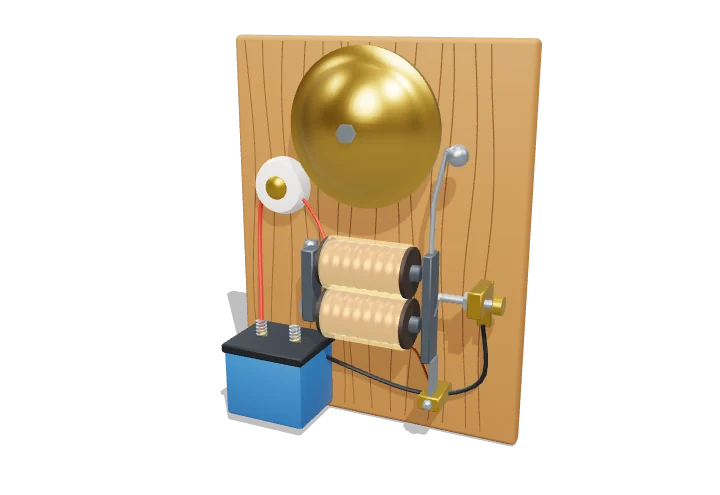
An electric bell has a magnet made from coils of wire that only works while electricity flows. The magnet pulls an iron arm so its hammer hits the gong — but moving the arm also breaks the circuit, so the magnet switches off and a spring flicks the arm back. That reconnects the circuit and the whole thing repeats 15–30 times a second.
An electric trembler bell uses an electromagnet to pull a soft-iron armature so that its hammer strikes a gong, while the same movement opens a contact in series with the electromagnet. The current stops, a spring returns the armature, the contact closes again, and this self-interrupting make-and-break cycle repeats many times a second for as long as the bell push is held.
Key facts
- Supply
- Typically 3–12 V: batteries or an 8–12 V AC bell transformer
- Ring (strike) rate
- ≈ 10–30 strikes per second
- Coil current
- ≈ 0.2–2 A while the contact is closed
- Circuit
- Series loop: supply, push, coils, armature, contact screw
- Core material
- Soft iron: high permeability, very low remanence
- Contact metals
- Platinum or silver tips to resist spark erosion
Parts you can explore (11)
- Baseboard
- Gong
- Electromagnet
- Armature
- Hammer
- Flat spring
- Contact screw
- Battery
- Bell push
- Wiring
- Sound waves
In the 3D model
Rotate and take apart the model, follow a guided tour of what each part does and why it’s needed, change it with a live slider, and test yourself with a short quiz. Free, no sign-up.
OpenArc Models’ models are simplified teaching schematics. Terms · Privacy