Physics
Electric dipole field
Electrostatics · Fields and potential
 Open the interactive 3D model →
How does a charge “know” another charge is there, even across empty space?
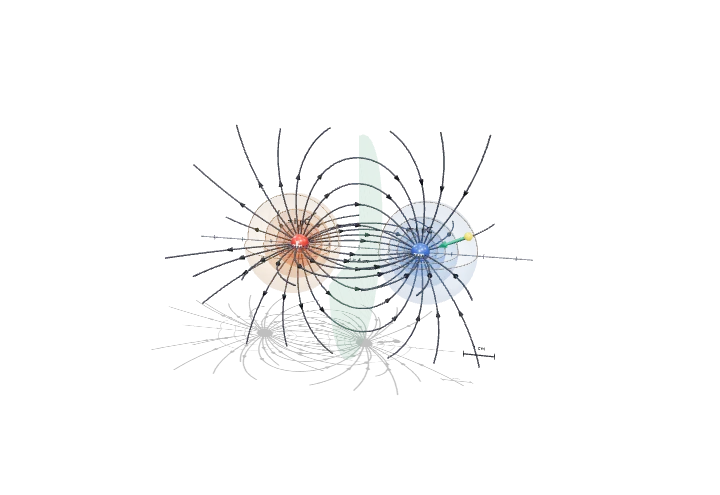
Every electric charge fills the space around it with an invisible electric field that pushes or pulls on other charges. Positive and negative charges attract, and two charges of the same sign repel. The lines in this model show which way that push would point everywhere around two charges.
Point charges create an electric field that points away from positive and toward negative charge, and the fields of several charges simply add as vectors. Field lines show the direction of E, while equipotential surfaces — always perpendicular to the lines — show where a charge would have the same potential energy.
Key facts
- Coulomb constant k
- 8.99 × 10⁹ N m² C⁻²
- Field of a point charge
- E = kq/r², radially outward for q > 0
- Dipole far field
- E ∝ p/r³
- Water molecule dipole moment
- 6.2 × 10⁻³⁰ C m (1.85 D)
- Dielectric breakdown of dry air
- ≈ 3 MV/m
- Model scale
- q₁ = +1 nC, charges 4 cm apart
Parts you can explore (9)
- Charge q₁
- Charge q₂
- Field lines
- Field direction arrows
- Equipotential surfaces
- Test charge
- Force arrow
- Neutral point
- Axis & scale
In the 3D model
Rotate and take apart the model, follow a guided tour of what each part does and why it’s needed, change it with a live slider, and test yourself with a short quiz. Free, no sign-up.
Open Electric dipole field in 3D →
OpenArc Models’ models are simplified teaching schematics. Terms · Privacy