Earth & space
El Niño–Southern Oscillation
Earth science · Ocean–atmosphere coupling
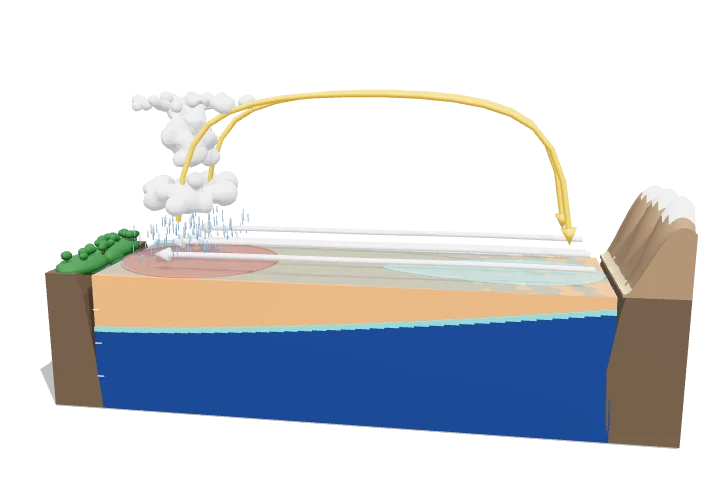 Open the interactive 3D model →
How can warm water drifting across the Pacific cause droughts in Australia and floods in Peru?
Steady winds along the equator usually push warm surface water across the Pacific towards Indonesia, where it fuels heavy rain. Every few years those winds weaken, the warm water sloshes back east, and the rain follows it. This swing, called El Niño, shifts weather patterns around the world for about a year.
The El Niño–Southern Oscillation (ENSO) is a coupled ocean–atmosphere cycle in the tropical Pacific in which the trade winds, the east–west tilt of the thermocline and the location of deep convection change together every 2–7 years. In El Niño the trades weaken and warm water and rainfall shift east; in La Niña the normal pattern intensifies, and both phases disturb weather around the world.
Key facts
- Recurrence
- irregular, every ≈ 2–7 years
- Typical duration
- ≈ 9–12 months (La Niña can persist 2–3 years)
- El Niño threshold (NOAA)
- ONI ≥ +0.5 °C for 5 overlapping seasons
- Strongest El Niño events (ONI peak)
- 1982–83, 1997–98 (+2.4 °C), 2015–16 (+2.6 °C)
- Normal thermocline depth
- ≈ 150–200 m west, ≈ 30–50 m east
- Warm-pool temperature
- ≥ 28–29 °C
Parts you can explore (11)
- Pacific Ocean surface
- Warm pool
- Warm surface layer
- Thermocline
- Cold deep water
- Trade winds
- Walker circulation
- Convection and rainfall
- Upwelling off Peru
- Maritime continent
- South America
In the 3D model
Rotate and take apart the model, follow a guided tour of what each part does and why it’s needed, change it with a live slider, and test yourself with a short quiz. Free, no sign-up.
Open El Niño–Southern Oscillation in 3D →
OpenArc Models’ models are simplified teaching schematics. Terms · Privacy