Plants & animals
Earthworm
Annelids · Segmented body plan
 Open the interactive 3D model →
How does an animal with no legs, no bones and no lungs tunnel through solid soil?
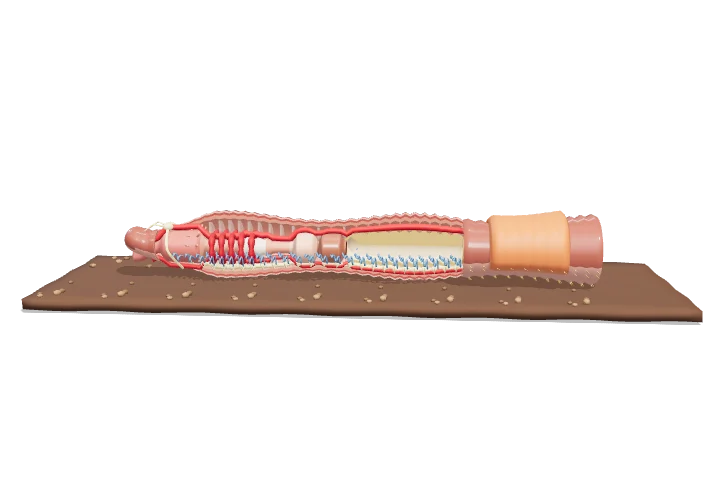
An earthworm is a chain of over a hundred ring-shaped segments, each filled with fluid like a little water balloon. By squeezing segments long and thin, then short and fat, in a wave down its body, it pushes itself through the soil. It eats the soil as it goes and breathes through its damp skin.
The earthworm Lumbricus terrestris is a segmented annelid whose body is a row of fluid-filled compartments, each with its own muscles, nerves, vessels and excretory organs. It crawls by waves of muscle contraction (peristalsis), eats its way through soil with a pharynx, crop, gizzard and long intestine, and pumps blood through a closed circulation driven by five pairs of aortic arches.
Key facts
- Segments
- ≈ 110–160 in L. terrestris
- Adult length
- Usually 15–25 cm, up to ≈ 30 cm
- Setae
- 8 per segment (4 pairs)
- Aortic arches
- 5 pairs, segments 7–11
- Clitellum
- Segments ≈ 31/32–37
- Gas exchange
- Through the moist skin; no lungs or gills
Parts you can explore (13)
- Body wall and segments
- Setae
- Clitellum
- Septa
- Pharynx and oesophagus
- Crop
- Gizzard
- Intestine and typhlosole
- Aortic arches
- Dorsal and ventral vessels
- Nerve cord and ganglia
- Nephridia
- Soil (context)
In the 3D model
Rotate and take apart the model, follow a guided tour of what each part does and why it’s needed, change it with a live slider, and test yourself with a short quiz. Free, no sign-up.
OpenArc Models’ models are simplified teaching schematics. Terms · Privacy