Earth & space
Earthquake faults
Seismology · Faults
 Open the interactive 3D model →
Solid rock can’t bend — so what actually snaps when the ground shakes?
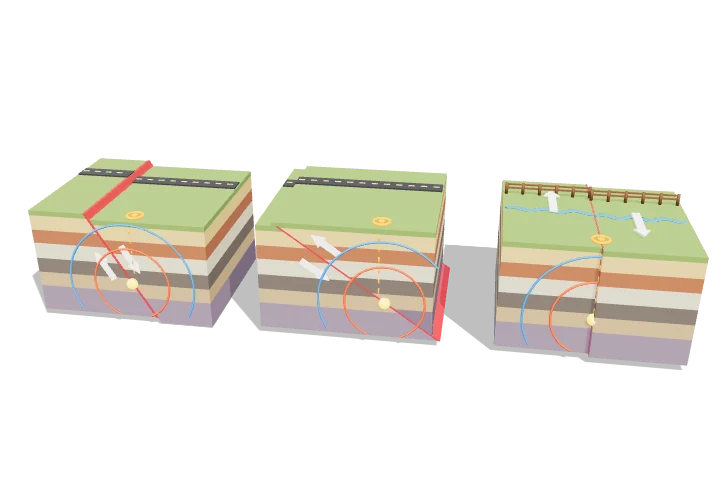
The Earth’s outer shell is broken into huge pieces that slowly push, pull and slide past each other. Where they meet, rock bends a little and stores energy, like a stretched spring. When the stress gets too big, the rock suddenly slips along a crack called a fault, and the stored energy shakes the ground as waves.
Earthquakes are sudden slip on faults that releases elastic strain built up by plate motion; the way the two sides move defines normal, reverse (thrust) and strike-slip faults. Rupture begins at the focus and radiates P and S body waves, and the size of the event is measured by the seismic moment, the product of rock rigidity, rupture area and slip.
Key facts
- Crustal P-wave speed
- ≈ 5.5–7 km/s
- Crustal S-wave speed
- ≈ 3–4 km/s (Vp/Vs ≈ 1.73)
- Typical focal depth (continental crust)
- ≈ 5–20 km
- Slip in an Mw 7 earthquake
- ≈ 1–5 m
- Energy per magnitude unit
- ≈ 32× (2 units ≈ 1000×)
- Largest recorded
- Mw 9.5, Chile 1960
Parts you can explore (12)
- Normal fault footwall
- Normal fault hanging wall
- Reverse fault footwall
- Reverse fault hanging wall
- Strike-slip blocks
- Fault planes
- Foci (hypocentres)
- Epicentres
- P-wave fronts
- S-wave fronts
- Slip arrows
- Offset markers
In the 3D model
Rotate and take apart the model, follow a guided tour of what each part does and why it’s needed, change it with a live slider, and test yourself with a short quiz. Free, no sign-up.
Open Earthquake faults in 3D →
OpenArc Models’ models are simplified teaching schematics. Terms · Privacy