Astronomy & space
Earth–Moon tides
Astronomy · Gravity and tides
 Open the interactive 3D model →
The Moon is on one side of Earth — so why is there also a high tide on the opposite side?
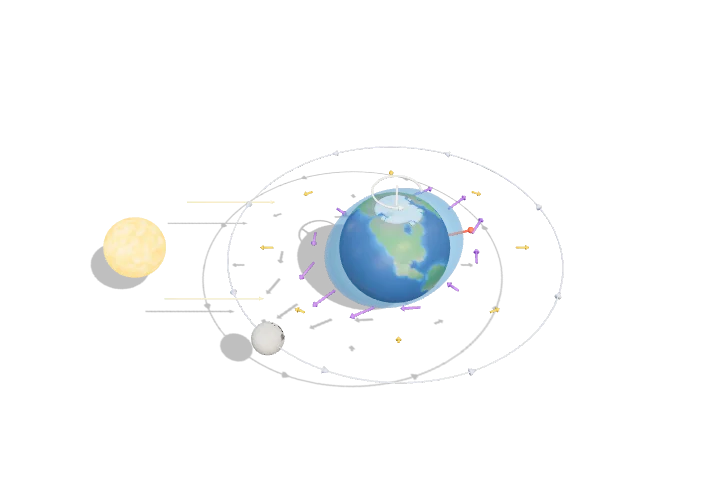
The Moon’s gravity pulls hardest on the side of Earth nearest to it and most weakly on the far side. That difference stretches the oceans into two bulges, one facing the Moon and one facing away. As Earth spins through both bulges each day, most beaches get two high tides and two low tides.
Tides are caused by the difference in the Moon’s and Sun’s gravitational pull across Earth, which stretches the oceans into two bulges, one facing the tide-raising body and one opposite. As Earth rotates beneath these bulges most coasts see two high tides a day, and the tides are largest (spring) when Sun and Moon line up and smallest (neap) when they are at right angles.
Key facts
- Earth–Moon distance
- 384 400 km mean (≈ 60 Earth radii)
- Moon’s mass
- 7.35 × 10²² kg (1/81 of Earth’s)
- Solar / lunar tidal force
- ≈ 0.46
- Lunar equilibrium tide range
- ≈ 0.54 m (open ocean, idealised)
- Interval between high tides
- ≈ 12 h 25 min (half a lunar day of 24 h 50 min)
- Spring–neap cycle
- ≈ 14.8 days (half the 29.53-day synodic month)
Parts you can explore (9)
- Earth
- Tidal bulges
- Moon
- Moon's orbit
- Sun
- Lunar tidal force
- Solar tidal force
- Tide gauge
- Earth's rotation
In the 3D model
Rotate and take apart the model, follow a guided tour of what each part does and why it’s needed, change it with a live slider, and test yourself with a short quiz. Free, no sign-up.
OpenArc Models’ models are simplified teaching schematics. Terms · Privacy