Astronomy & space
Earth’s magnetosphere
Space physics · Planetary magnetism
 Open the interactive 3D model →
The Sun blasts a wind of charged particles at Earth at 400 km/s — so why isn’t our atmosphere stripped away?
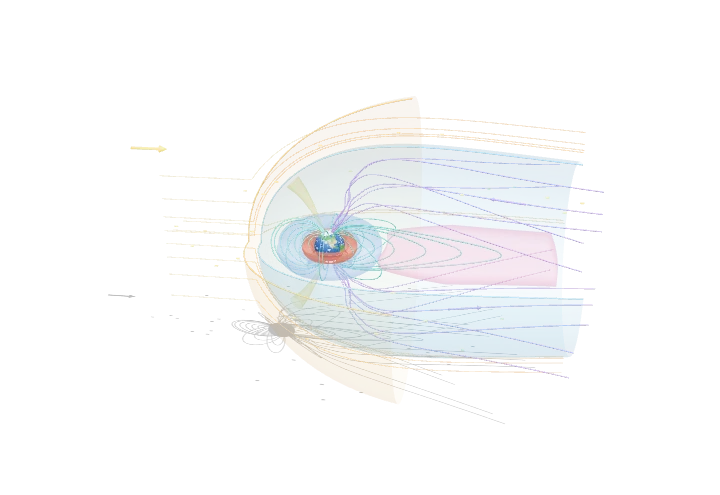
Earth is a giant magnet, and its magnetic field forms an invisible bubble around the planet called the magnetosphere. The solar wind, a stream of charged particles from the Sun, is pushed aside by this bubble instead of hitting us directly. The wind squashes the bubble on the side facing the Sun and stretches it into a long tail on the night side, and particles that leak in make the northern and southern lights.
Earth’s magnetic field carves a cavity in the supersonic solar wind: a bow shock stands upstream, the magnetopause marks where the wind’s pressure balances magnetic pressure, and the nightside field is drawn out into a long magnetotail. Inside, trapped particles form the Van Allen belts and energy released in the tail drives the aurora.
Key facts
- Subsolar magnetopause
- ≈ 10 R_E typical (6–12 R_E); R_E = 6,371 km
- Bow shock nose
- ≈ 13–15 R_E upstream
- Dipole moment
- ≈ 8 × 10²² A m²; equatorial surface field ≈ 30 µT
- Inner / outer belt
- ≈ 1.2–2.5 R_E protons / ≈ 3–7 R_E electrons
- Magnetotail length
- Several hundred R_E (Moon orbits at 60 R_E)
- Auroral ovals
- ≈ 65–75° magnetic latitude
Parts you can explore (12)
- Earth
- Bow shock
- Magnetosheath
- Magnetopause
- Closed field lines
- Magnetotail lobes
- Plasma sheet
- Inner Van Allen belt
- Outer Van Allen belt
- Polar cusps
- Auroral ovals
- Solar wind
In the 3D model
Rotate and take apart the model, follow a guided tour of what each part does and why it’s needed, change it with a live slider, and test yourself with a short quiz. Free, no sign-up.
Open Earth’s magnetosphere in 3D →
OpenArc Models’ models are simplified teaching schematics. Terms · Privacy