Earth & space
Earth’s interior (cutaway)
Earth science · Layered planet
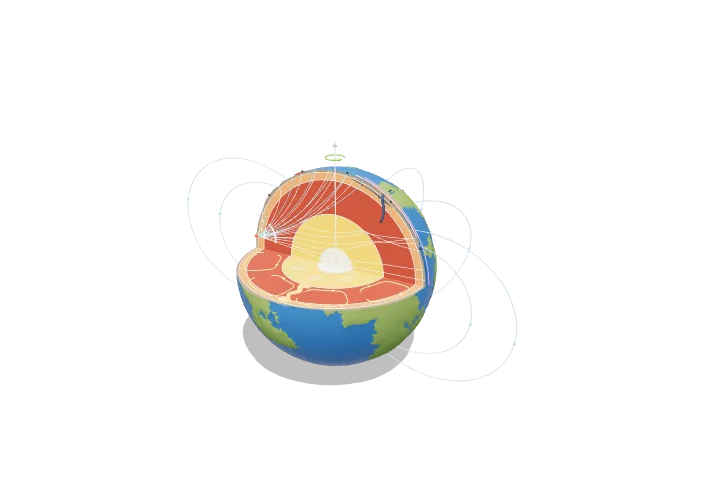 Open the interactive 3D model →
Nobody has drilled even 13 km down — so how do we know Earth has a liquid iron core?
Earth is built in layers, like an onion: a thin rocky crust, a thick mantle of hot rock, and a metal core whose outer part is liquid and inner part solid. We learned this by listening to earthquakes, whose waves bend, speed up and sometimes vanish as they travel through the planet.
Seismology shows that Earth is layered into a thin crust, a solid but slowly convecting silicate mantle (upper and lower), a liquid iron-alloy outer core and a solid inner core, separated by sharp jumps in seismic velocity and density. Heat escaping from the interior (≈ 46 TW) drives mantle convection and plate tectonics, and convection in the liquid outer core sustains the geomagnetic field.
Key facts
- Mean radius
- 6,371 km
- Crust thickness
- Oceanic ≈ 5–10 km; continental ≈ 30–50 km (up to ≈ 70 km)
- Upper / lower mantle
- ≈ 35–660 km / 660–2,891 km depth
- Core–mantle boundary
- 2,891 km depth (radius 3,480 km), ≈ 136 GPa
- Inner-core boundary
- 5,150 km depth (radius 1,221 km), ≈ 329 GPa
- Surface heat flow
- ≈ 46–47 TW (≈ 87 mW/m² average)
Parts you can explore (13)
- Crust
- Upper mantle
- Lower mantle
- Outer core
- Inner core
- Layer boundaries
- Seismic wave paths
- Plate boundary markers
- Mantle convection arrows
- Mantle plume
- Outer-core flow swirls
- Magnetic field schematic
- Spin axis
In the 3D model
Rotate and take apart the model, follow a guided tour of what each part does and why it’s needed, change it with a live slider, and test yourself with a short quiz. Free, no sign-up.
Open Earth’s interior (cutaway) in 3D →
OpenArc Models’ models are simplified teaching schematics. Terms · Privacy