Electromagnetism & electronics
Dynamic microphone
Electromagnetism · Transducers
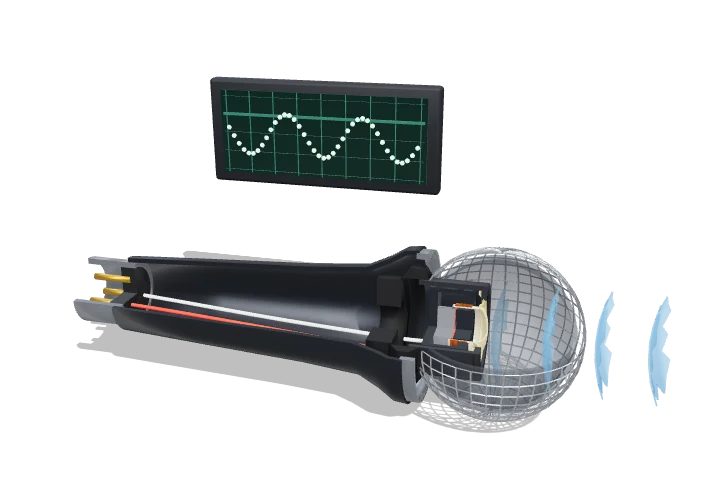 Open the interactive 3D model →
How can a singer’s voice, just tiny wobbles in the air, become an electrical signal without any battery?
Inside a dynamic microphone is a thin, light skin called a diaphragm with a tiny coil of wire glued to it. Sound pushes the diaphragm back and forth, so the coil moves in and out next to a strong magnet. A wire moving near a magnet makes electricity, so the coil produces a small voltage that wiggles exactly like the sound.
A dynamic microphone converts sound into an electrical signal by electromagnetic induction: sound pressure moves a light diaphragm, and the voice coil attached to it moves through a strong radial magnetic field. The induced EMF is proportional to the coil’s velocity, so the output voltage reproduces the sound waveform without any external power.
Key facts
- Principle
- Moving-coil induction, ε = Blv
- Typical sensitivity
- ≈ 1.5–2.5 mV/Pa (about −55 dBV/Pa)
- Output at 94 dB SPL (1 Pa)
- ≈ 2 mV rms
- Gap flux density
- ≈ 1 T
- Typical frequency response
- ≈ 50 Hz–15 kHz (vocal models)
- Power needed
- None (passive transducer)
Parts you can explore (13)
- Grille
- Foam windscreen
- Diaphragm
- Voice coil
- Permanent magnet
- Pole piece and yoke
- Cartridge housing
- Shock mount
- Housing
- Signal wires
- XLR connector
- Sound waves
- Output waveform
In the 3D model
Rotate and take apart the model, follow a guided tour of what each part does and why it’s needed, change it with a live slider, and test yourself with a short quiz. Free, no sign-up.
Open Dynamic microphone in 3D →
OpenArc Models’ models are simplified teaching schematics. Terms · Privacy