Mechanisms
Drum brake
Machines · Friction brakes
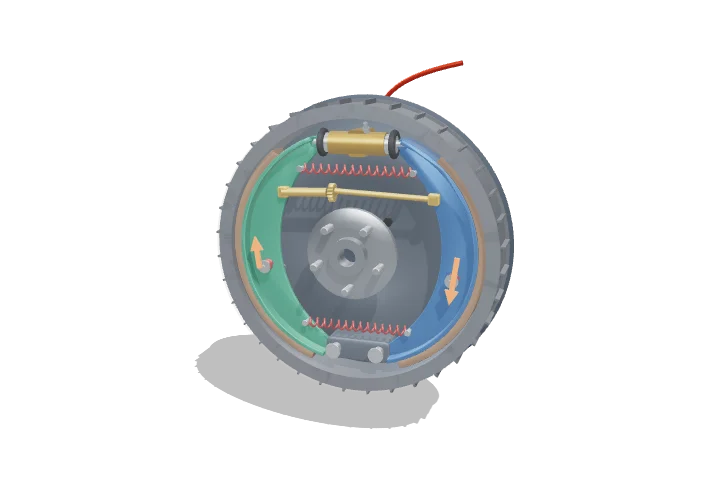 Open the interactive 3D model →
Why does one brake shoe in a car wheel press over twice as hard as its twin, given the same push?
When you press the brake pedal, fluid pressure pushes two curved shoes outwards against the inside of a drum that spins with the wheel. Rubbing turns the car’s motion into heat. The spinning drum drags one shoe harder into contact, so that shoe does most of the braking.
In a drum brake, hydraulic pressure in a wheel cylinder pushes two curved shoes outwards so that their friction linings rub on the inside of a drum turning with the wheel. Because each shoe pivots on an anchor, friction either helps or opposes the applying force: the leading shoe is self-energising and, in this model, gives about 2.5 times the torque of the trailing shoe for the same force.
Key facts
- Model drum diameter
- 230 mm
- Wheel-cylinder bore
- 19.05 mm (¾ in), A = 285 mm²
- Lining friction coefficient (model)
- μ = 0.35 (typical 0.3–0.45)
- Leading/trailing torque ratio (model)
- ≈ 2.5
- Shoe factor, both shoes (torque ÷ F·r)
- ≈ 2.0
- Real running clearance
- ≈ 0.2–0.5 mm (exaggerated ×10 in the model)
Parts you can explore (12)
- Brake drum
- Backing plate
- Leading shoe
- Trailing shoe
- Friction linings
- Wheel cylinder
- Return springs
- Self-adjuster
- Anchor block
- Hold-down springs
- Brake line
- Friction forces
In the 3D model
Rotate and take apart the model, follow a guided tour of what each part does and why it’s needed, change it with a live slider, and test yourself with a short quiz. Free, no sign-up.
OpenArc Models’ models are simplified teaching schematics. Terms · Privacy