Physics
Double-slit interference
Wave optics · Interference
 Open the interactive 3D model →
How can shining light through two tiny slits make stripes of darkness where light should be?
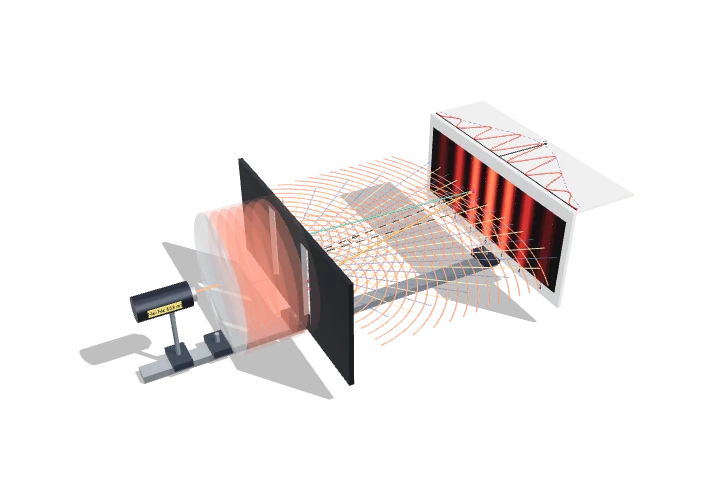
Light travels as waves, like ripples on a pond. When light passes through two narrow slits, the ripples from each slit spread out and overlap. Where crest meets crest the light is extra bright, and where crest meets trough the waves cancel and leave darkness — so the screen shows a row of bright and dark stripes.
When coherent light passes through two narrow, closely spaced slits, the two emerging waves overlap and interfere, producing evenly spaced bright and dark fringes on a distant screen. The fringe spacing Δy = λL/d lets a ruler measure the wavelength of light, and the experiment was the decisive early evidence that light is a wave.
Key facts
- Bright fringes
- d sinθ = mλ (m = 0, ±1, ±2 …)
- Dark fringes
- d sinθ = (m + ½)λ
- Fringe spacing (small angles)
- Δy = λL/d
- He–Ne laser wavelength
- 632.8 nm
- Typical slit separation
- 0.1–0.5 mm
- Model scale
- λ and d drawn ≈ 10⁵ and ≈ 10⁴ × real
Parts you can explore (9)
- Optical bench
- Laser
- Incident plane waves
- Double-slit barrier
- Circular wavefronts
- Interference lines
- Viewing screen
- Intensity graph
- Path difference
In the 3D model
Rotate and take apart the model, follow a guided tour of what each part does and why it’s needed, change it with a live slider, and test yourself with a short quiz. Free, no sign-up.
Open Double-slit interference in 3D →
OpenArc Models’ models are simplified teaching schematics. Terms · Privacy