Physics
Doppler effect
Waves · Sound
 Open the interactive 3D model →
Why does an ambulance siren suddenly drop in pitch the moment it rushes past you?
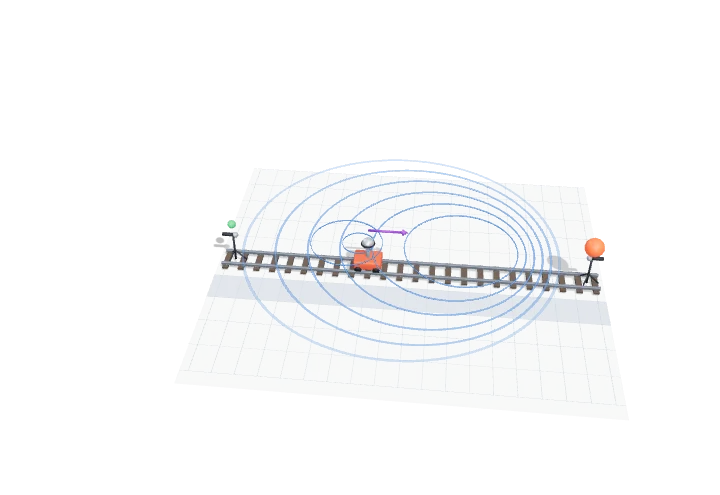
Sound travels through air as ripples spreading out from where they were made. A moving siren keeps catching up with the ripples in front of it, squashing them together, and leaves the ones behind spread out. Squashed ripples sound higher and stretched ones lower.
When a sound source moves through air, each wavefront spreads from the point where it was emitted, so fronts crowd together ahead of the source and spread apart behind it, and stationary listeners hear f′ = f·v/(v ∓ v_s). When the source outruns its own sound the fronts merge into a Mach cone, a shock wave heard as a sonic boom.
Key facts
- Speed of sound in air
- 343 m/s at 20 °C
- Moving source, observer ahead
- f′ = f·v/(v − v_s)
- Moving source, observer behind
- f′ = f·v/(v + v_s)
- Model example (Mach 0.5, 440 Hz)
- 880 Hz ahead, 293 Hz behind
- Mach angle
- sin μ = v/v_s = 1/M
- Car at 30 m/s, 440 Hz horn
- 482 Hz approaching, 405 Hz receding
Parts you can explore (9)
- Sound source
- Track
- Source velocity
- Wavefronts
- Mach cone
- Observer ahead
- Observer behind
- Wavelength markers
- Air medium
In the 3D model
Rotate and take apart the model, follow a guided tour of what each part does and why it’s needed, change it with a live slider, and test yourself with a short quiz. Free, no sign-up.
OpenArc Models’ models are simplified teaching schematics. Terms · Privacy