Cells & molecules
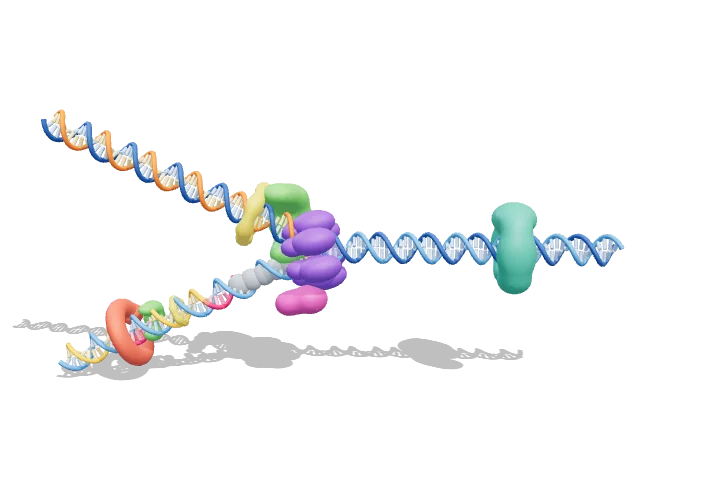
DNA replication fork
Molecular biology · Replication
 Open the interactive 3D model →
Before a cell divides it must copy all of its DNA — how does it do that without mistakes?
DNA is two strands twisted together, and each strand carries the pattern for the other. To copy it, a cell prises the two strands apart and builds a matching new partner for each one. A team of proteins does the work: one unzips the helix, another lays down starting blocks, and copying machines fill in the new strands.
DNA replication is semiconservative: each parental strand serves as the template for a new complementary strand at a moving replication fork. Because DNA polymerases only extend 3′ ends, one strand is made continuously and the other in short, primed Okazaki fragments that are later joined.
Key facts
- Fork speed, E. coli
- ≈ 500–1,000 nt/s
- Fork speed, human cells
- ≈ 20–50 nt/s (≈ 1–3 kb/min)
- Okazaki fragments
- ≈ 1,000–2,000 nt (bacteria); 100–200 nt (eukaryotes)
- RNA primer length
- ≈ 10–12 nt (bacteria); ≈ 8–10 nt + short DNA (eukaryotes)
- Error rate after proofreading and repair
- ≈ 10⁻¹⁰ per bp per replication
- Origins
- 1 in E. coli; ~30,000–50,000 used per human S phase
Parts you can explore (12)
- Parental DNA
- Helicase
- Topoisomerase
- SSB proteins
- Primase
- RNA primers
- DNA polymerase III
- Sliding clamps
- Leading strand
- Lagging-strand template
- Okazaki fragments
- DNA ligase
In the 3D model
Rotate and take apart the model, follow a guided tour of what each part does and why it’s needed, change it with a live slider, and test yourself with a short quiz. Free, no sign-up.
Open DNA replication fork in 3D →
OpenArc Models’ models are simplified teaching schematics. Terms · Privacy