Cells & molecules
DNA double helix
Biology · Molecular structure
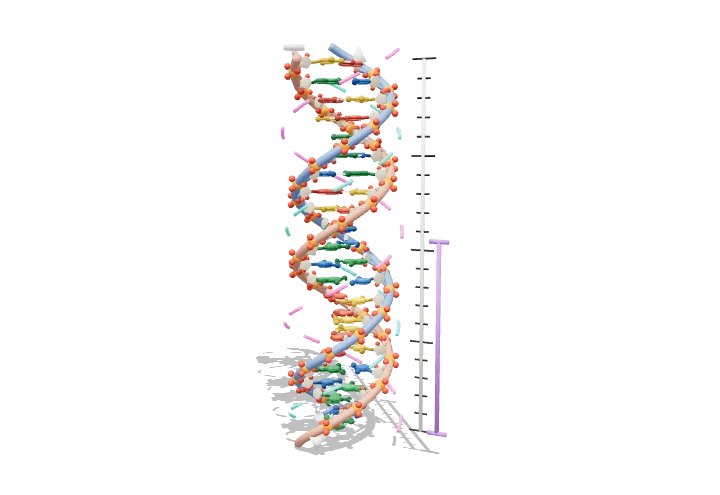 Open the interactive 3D model →
How do two metres of instructions fit in every cell — and get copied without mistakes?
DNA is a long molecule shaped like a twisted ladder. Its rungs are pairs of four chemical letters — A, T, G and C — and A always pairs with T while G always pairs with C. Because each side fixes the other, a cell can split the ladder and rebuild two perfect copies.
DNA is a double helix of two antiparallel sugar–phosphate strands held together by complementary base pairs, A with T and G with C, stacked 0.34 nm apart with 10.5 pairs per turn. Complementarity lets each strand act as a template for copying, and the uneven spacing of the backbones creates major and minor grooves where proteins read the sequence without unwinding the helix.
Key facts
- Helix diameter
- ≈ 2.0 nm
- Rise per base pair
- ≈ 0.34 nm
- Twist per base pair
- ≈ 34.3° → 10.5 bp per turn (B-DNA in solution)
- Helical pitch
- ≈ 3.4–3.6 nm per turn
- Human genome (haploid)
- ≈ 3.1 × 10⁹ bp; ≈ 2 m of DNA per diploid cell
- Human GC content
- ≈ 41%
Parts you can explore (11)
- Backbone strand 1
- Backbone strand 2
- A–T base pairs
- G–C base pairs
- Sugar units
- Phosphate units
- Hydrogen bond dashes
- Major groove marker
- Minor groove marker
- Strand direction markers
- Pitch ruler
In the 3D model
Rotate and take apart the model, follow a guided tour of what each part does and why it’s needed, change it with a live slider, and test yourself with a short quiz. Free, no sign-up.
OpenArc Models’ models are simplified teaching schematics. Terms · Privacy