Chemistry
Fractional distillation
Separation techniques · Physical chemistry
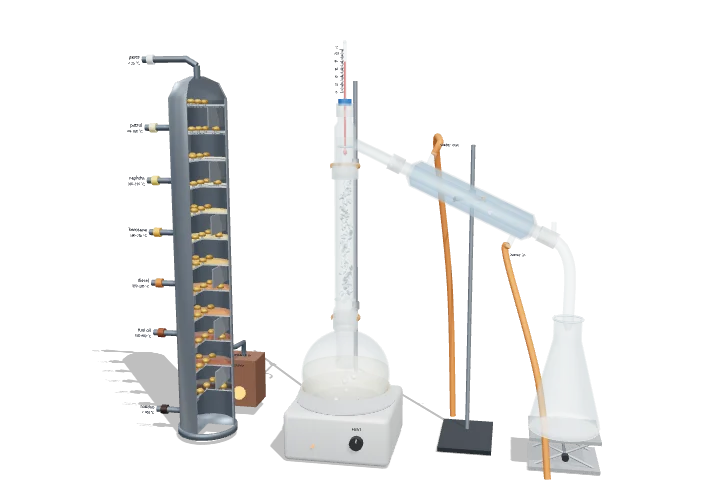 Open the interactive 3D model →
How can you pull alcohol out of water when both are clear liquids that mix perfectly?
Ethanol boils at 78 °C and water at 100 °C, so when the mixture boils the vapour carries more ethanol than the liquid. A tall column lets that vapour cool, drip back and boil again many times, and each round leaves it richer in ethanol. A cold tube then turns the vapour back into liquid that drips into a flask.
Fractional distillation separates liquids with different boiling points by letting rising vapour and falling liquid exchange heat and matter many times along a column, so the vapour leaving the top is greatly enriched in the more volatile component. The same principle, run continuously on trays, splits crude oil into fractions in a refinery.
Key facts
- Boiling point of ethanol
- 78.4 °C (1 atm)
- Boiling point of water
- 100.0 °C (1 atm)
- Ethanol–water azeotrope
- ≈ 95.6% ethanol by mass, b.p. 78.2 °C
- Enthalpy of vaporisation of ethanol
- 38.6 kJ mol⁻¹ at its boiling point
- Refinery column height
- ≈ 50–70 m, typically 30–50 trays
Parts you can explore (16)
- Heating mantle
- Round-bottom flask
- Boiling mixture
- Fractionating column
- Column packing
- Still head
- Thermometer
- Liebig condenser
- Cooling water
- Receiver adapter and flask
- Distillate
- Vapour and reflux
- Condensate drops
- Clamps and stands
- Industrial crude-oil column
- Fraction draw-offs
In the 3D model
Rotate and take apart the model, follow a guided tour of what each part does and why it’s needed, change it with a live slider, and test yourself with a short quiz. Free, no sign-up.
Open Fractional distillation in 3D →
OpenArc Models’ models are simplified teaching schematics. Terms · Privacy