Fluids & heat
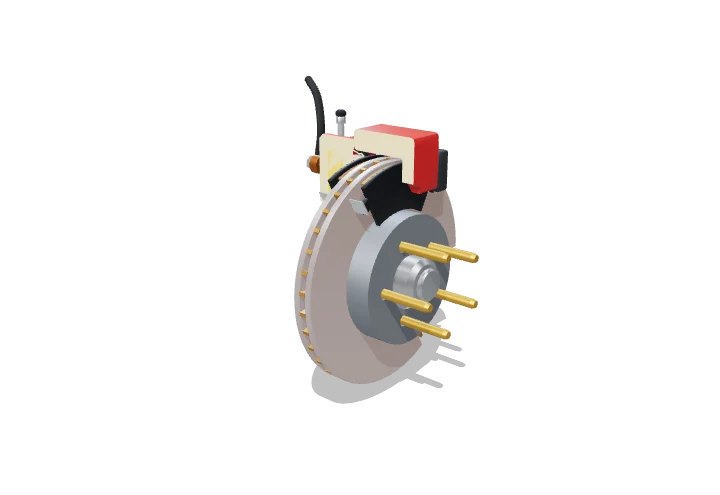
Floating-caliper disc brake
Automotive · Friction braking
 Open the interactive 3D model →
How can a squeeze from your foot stop a one-and-a-half-tonne car in a few seconds?
Pressing the brake pedal pushes fluid down a pipe to a small piston at each wheel. The piston squeezes two pads against a spinning iron disc, and the rubbing turns the car’s motion into heat. The disc gets hot and then cools in the air.
A disc brake stops a wheel by clamping friction pads against a rotor, converting the vehicle’s kinetic energy into heat stored in the rotor and then shed to the air. Hydraulic pressure on the piston sets the clamp force, friction and effective radius set the brake torque, and the rotor’s mass and cooling decide how hot it gets.
Key facts
- Clamp force
- F = p × A_piston (model: 22.9 kN at 10 MPa on a 54 mm piston)
- Brake torque
- T = 2 μ F r_eff (two friction faces)
- Pad friction coefficient (cars)
- μ ≈ 0.35–0.5
- Line pressure, hard stop
- ≈ 5–10 MPa (50–100 bar)
- Grey-iron disc temperature, hard road use
- ≈ 300–500 °C; > 600 °C on track
- Energy of a 1500 kg car at 100 km/h
- ≈ 580 kJ
Parts you can explore (13)
- Brake rotor
- Cooling vanes
- Wheel hub
- Caliper body
- Piston
- Piston seal & dust boot
- Brake fluid
- Inner pad
- Outer pad
- Caliper bracket
- Guide pins
- Pad clips & wear indicator
- Brake line & bleed
In the 3D model
Rotate and take apart the model, follow a guided tour of what each part does and why it’s needed, change it with a live slider, and test yourself with a short quiz. Free, no sign-up.
Open Floating-caliper disc brake in 3D →
OpenArc Models’ models are simplified teaching schematics. Terms · Privacy