Human body
Digestive system
Anatomy · Digestive system
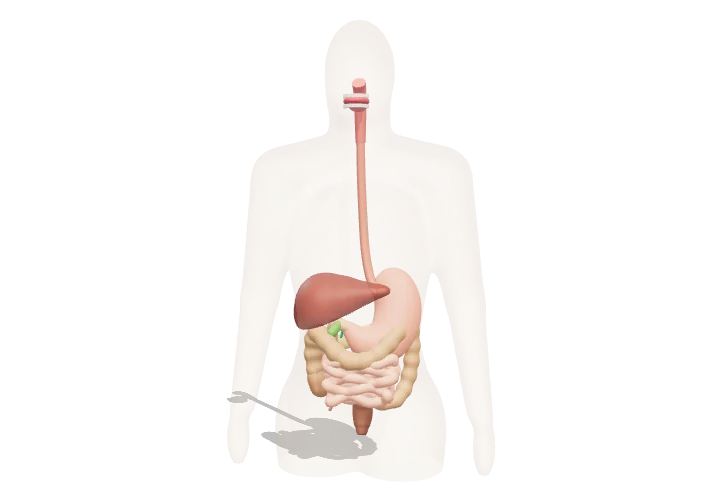 Open the interactive 3D model →
Where does a sandwich actually go after you swallow it — and why does the trip take a day or more?
Your digestive system is one long tube, about 8 metres, running from your mouth to your bottom. Along the way food is mashed, mixed with acid and digestive juices, and broken into tiny molecules that pass into your blood, mostly in the small intestine. The large intestine then soaks up water, and what is left leaves as faeces.
The digestive system is a continuous tube from mouth to anus, helped by accessory organs, that breaks food down mechanically and chemically and absorbs the products. Each region is specialised for a step — storage, mixing, enzymatic digestion, absorption or water recovery — and transit time varies from seconds in the oesophagus to a day or more in the colon.
Key facts
- Alimentary canal length
- ≈ 8–9 m in a cadaver (shorter with muscle tone in life)
- Small intestine
- ≈ 6 m (duodenum ≈ 25 cm, jejunum ≈ 2.5 m, ileum ≈ 3.5 m)
- Large intestine
- ≈ 1.5 m
- Fluid entering gut per day
- ≈ 8–9 L (≈ 2 L intake + ≈ 7 L secretions)
- Whole-gut transit time
- ≈ 24–72 h
- Small-intestine absorptive area
- ≈ 30 m² (mucosal folds, villi, microvilli)
Parts you can explore (14)
- Body outline
- Mouth
- Pharynx
- Oesophagus
- Stomach
- Liver
- Gallbladder
- Pancreas
- Duodenum
- Small intestine
- Caecum & appendix
- Colon
- Rectum & anal canal
- Food bolus
In the 3D model
Rotate and take apart the model, follow a guided tour of what each part does and why it’s needed, change it with a live slider, and test yourself with a short quiz. Free, no sign-up.
OpenArc Models’ models are simplified teaching schematics. Terms · Privacy