Mechanisms
Open differential
Mechanisms · Automotive drivetrain
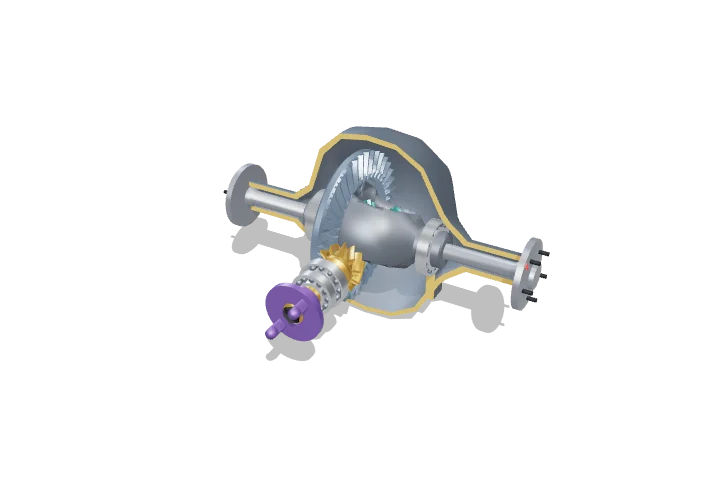 Open the interactive 3D model →
When a car turns a corner, how can one engine drive two wheels that are spinning at different speeds?
In a turn, the outside wheel travels a bigger circle than the inside wheel, so it has to spin faster. The differential is a clever box of gears between the two driven wheels that lets them turn at different speeds while still pushing both. Without it, one tyre would have to skid every time the car turned.
An open differential is a bevel-gear epicyclic train that delivers equal torque to two output shafts while letting their speeds differ, so the carrier speed is always the average of the two wheel speeds. A spiral-bevel or hypoid final drive in front of it reduces the driveshaft speed and turns the power flow through 90°.
Key facts
- Speed relation
- ω_L + ω_R = 2 ω_carrier
- Torque split (ideal open diff)
- 50 : 50 between the wheels
- Final-drive ratio shown
- 41 : 11 ≈ 3.73 : 1
- Typical passenger-car final drive
- ≈ 2.5–4.5 : 1
- Gears in this model
- ring 41, pinion 11, side gears 16, spiders 10
- Outer/inner wheel speed, 10 m turn, 1.5 m track
- ≈ 1.16
Parts you can explore (10)
- Drive pinion
- Pinion yoke
- Ring gear
- Differential carrier
- Cross shaft
- Spider gears
- Side gears
- Axle shafts
- Bearings
- Axle housing
In the 3D model
Rotate and take apart the model, follow a guided tour of what each part does and why it’s needed, change it with a live slider, and test yourself with a short quiz. Free, no sign-up.
Open Open differential in 3D →
OpenArc Models’ models are simplified teaching schematics. Terms · Privacy