Power & energy
Diesel engine
Engines · Turbo-diesel common rail
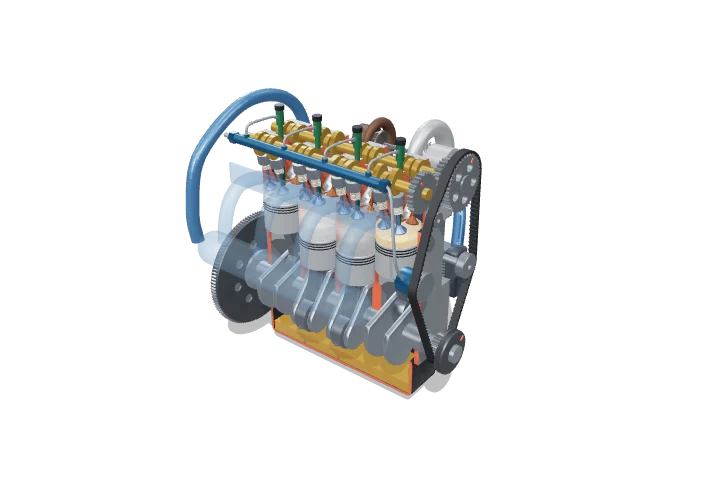 Open the interactive 3D model →
How does a diesel engine set its fuel on fire without a single spark?
A diesel engine squeezes air into about one-seventeenth of its space, so hard that the air heats up to over 500 °C. Fuel sprayed into that hot air catches fire by itself, and the burning gas pushes the pistons down to turn the crankshaft. Because it squeezes harder than a petrol engine, it gets more work out of every drop of fuel.
A diesel engine compresses air alone so strongly — here 17 : 1 — that it becomes hot enough to ignite fuel injected directly into the cylinder near top dead centre, with no spark. Because load is controlled by the amount of fuel rather than by throttling the air, and because the compression ratio is high, diesels are the most efficient common reciprocating engines, especially when turbocharged.
Key facts
- Compression ratio (model)
- 17 : 1 (passenger-car diesels ≈ 15–18 : 1)
- Air at end of compression
- ≈ 4–5 MPa, ≈ 800–900 K
- Injection pressure (common rail)
- ≈ 300–2000+ bar
- Model geometry
- bore 84 mm × stroke 90 mm → 2.0 L
- Ideal diesel efficiency at r = 17, ρ = 2
- ≈ 62%
- Best brake efficiency
- ≈ 40–45% (cars), ≈ 50% (large trucks, ships)
Parts you can explore (16)
- Engine block
- Pistons
- Connecting rods
- Crankshaft
- Flywheel
- Cylinder head
- Camshafts
- Valves
- Common rail
- Injectors
- Glow plugs
- Intake manifold
- Exhaust manifold
- Turbocharger
- Intercooler
- Combustion gases
In the 3D model
Rotate and take apart the model, follow a guided tour of what each part does and why it’s needed, change it with a live slider, and test yourself with a short quiz. Free, no sign-up.
OpenArc Models’ models are simplified teaching schematics. Terms · Privacy