Plants & animals
Centric diatom
Protists · Diatom
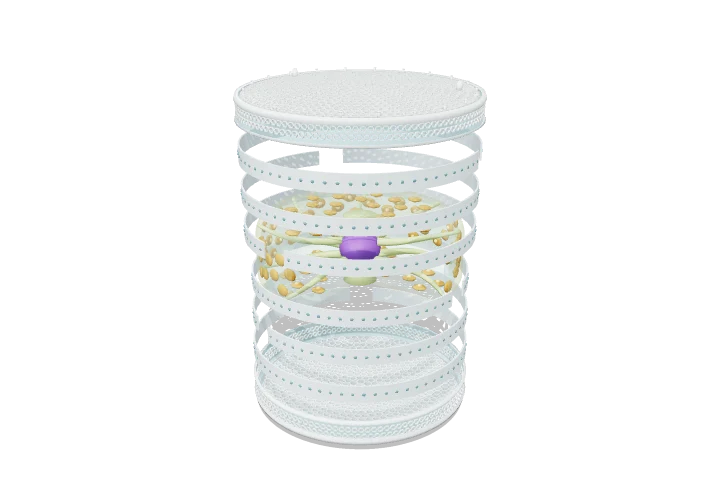 Open the interactive 3D model →
How does a single cell, too small to see, build itself a box made of glass?
A diatom is a tiny alga made of just one cell, living inside a see-through wall of glass-like silica. The wall has two halves that fit together like a pill box, and it is full of tiny holes that let food and gases through. Diatoms make roughly one breath in every five you take: they produce about a fifth of the oxygen and food made by photosynthesis on Earth.
Diatoms are single-celled photosynthetic algae enclosed in a two-part wall of glass-like silica, the frustule, whose valves are perforated by intricate, species-specific pore patterns. Because each new valve is built inside the parent wall, one daughter cell is slightly smaller after every division until sexual reproduction restores full size.
Key facts
- Typical size
- ≈ 20–200 µm (range ~2 µm to ~2 mm)
- Wall material
- Hydrated amorphous silica, SiO₂·nH₂O
- Share of global primary production
- ≈ 20 % (≈ 40 % of marine)
- Pigments
- Chlorophyll a, c and fucoxanthin
- Division rate
- ≈ 1–3 per day under good conditions
- Areola (pore) spacing
- ≈ 0.5–3 µm, species specific
Parts you can explore (9)
- Epivalve
- Hypovalve
- Girdle bands
- Rimoportulae
- Cytoplasm
- Vacuole
- Chloroplasts
- Nucleus
- Daughter valves
In the 3D model
Rotate and take apart the model, follow a guided tour of what each part does and why it’s needed, change it with a live slider, and test yourself with a short quiz. Free, no sign-up.
OpenArc Models’ models are simplified teaching schematics. Terms · Privacy