Fluids & heat
Diaphragm pump
Fluid machinery · Positive-displacement pump
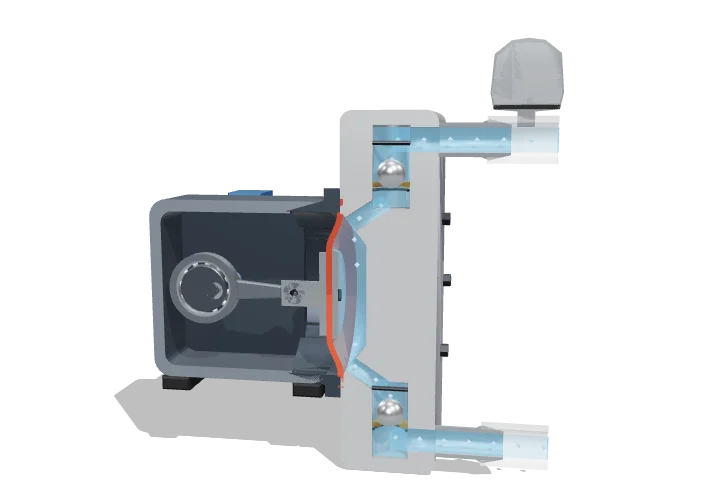 Open the interactive 3D model →
How can a wobbling rubber disc and two loose balls pump liquid without a single leaky seal?
A diaphragm pump has a rubber wall that a motor pushes in and pulls out, over and over. When the wall pulls back, liquid is sucked in through one valve; when it pushes in, liquid is squeezed out through another. Two little balls act as one-way doors so the liquid can only go forward.
A diaphragm pump is a reciprocating positive-displacement pump in which a flexible membrane, driven back and forth by an eccentric and connecting rod, changes the volume of a sealed chamber. Two passive check valves make the flow one-way: liquid enters through the inlet valve on the suction stroke and leaves through the outlet valve on the discharge stroke.
Key facts
- Swept volume (this model)
- ≈ 8.2 cm³ per stroke (A_eff ≈ 1130 mm², stroke 7.2 mm)
- Flow (this model)
- ≈ 10 L/min at 1400 strokes/min, η_v ≈ 0.9
- Typical stroke rates
- ≈ 50–200 /min (metering, AODD) up to ≈ 3000 /min (small motor pumps)
- Typical pressures
- ≈ 1–8 bar (motor and air-driven); metering pumps to ≈ 20 bar and more
- Peak-to-mean flow (single head)
- ≈ π : 1 without a dampener
- Key advantage
- Liquid is sealed from the drive: no shaft seal to leak
Parts you can explore (14)
- Pump head
- Diaphragm
- Pumping chamber
- Clamp plates
- Connecting rod
- Eccentric and bearing
- Crankcase
- Drive motor
- Inlet check valve
- Outlet check valve
- Inlet port
- Outlet port
- Pulsation dampener
- Flow tracers
In the 3D model
Rotate and take apart the model, follow a guided tour of what each part does and why it’s needed, change it with a live slider, and test yourself with a short quiz. Free, no sign-up.
OpenArc Models’ models are simplified teaching schematics. Terms · Privacy