Physics
Cyclotron
Particle accelerators · Electromagnetism
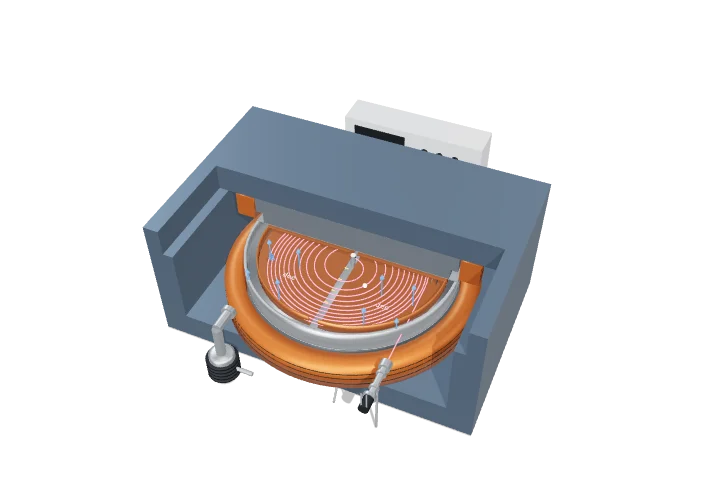 Open the interactive 3D model →
How can a machine the size of a dining table speed protons up to a quarter of the speed of light?
A cyclotron gives protons hundreds of small pushes instead of one huge one. A big magnet bends them round in circles so they keep coming back to the same gap, where a voltage kicks them a little faster each time. As they speed up they spiral outwards, until they are fired at a target.
A cyclotron accelerates ions by passing them hundreds of times through the same modest voltage: a uniform magnetic field bends them into circles inside two hollow D-shaped electrodes, and an alternating voltage across the gap kicks them forward on every crossing. Because the orbital period 2πm/qB does not depend on speed, a single fixed radio frequency keeps in step as the ions spiral outward to an energy (qBR)²/2m.
Key facts
- Cyclotron frequency (proton)
- f = qB/2πm ≈ 15.2 MHz per tesla
- Final energy
- E = (qBR)²/2m: ≈ 27 MeV for B = 1.5 T, R = 0.5 m
- Energy gain per turn
- 2qV: ≈ 100 keV for 50 kV across the gap
- Turns to full energy
- hundreds (≈ 270 in the default setting)
- Classical limit (protons)
- ≈ 20–25 MeV, set by relativistic mass increase
- First cyclotron
- Lawrence & Livingston, 1931: 11 cm diameter, 80 keV
Parts you can explore (13)
- Magnet yoke
- Pole pieces
- Magnet coils
- Vacuum chamber
- Dees
- Accelerating gap
- RF oscillator
- Ion source
- Magnetic field
- Ion beam
- Deflector & beam line
- Target
- Vacuum pump
In the 3D model
Rotate and take apart the model, follow a guided tour of what each part does and why it’s needed, change it with a live slider, and test yourself with a short quiz. Free, no sign-up.
OpenArc Models’ models are simplified teaching schematics. Terms · Privacy