Chemistry
Cyclohexane conformations
Organic chemistry · Conformational analysis
 Open the interactive 3D model →
Why is a ring of six carbon atoms not flat — and why does it flip inside out 100,000 times a second?
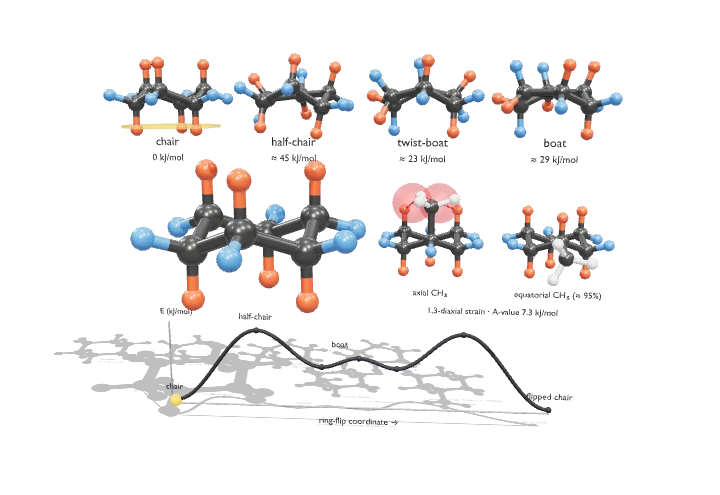
Cyclohexane is a ring of six carbon atoms, each carrying two hydrogens. A flat ring would squeeze its bonds and crowd its hydrogens, so the ring puckers into a zig-zag “chair” shape. Each carbon then has one hydrogen pointing straight up or down (axial) and one pointing outward (equatorial), and the ring keeps flipping between two chairs, swapping the two kinds.
Cyclohexane avoids angle and torsional strain by puckering into a chair in which every bond is staggered and each carbon carries one axial and one equatorial hydrogen. At room temperature the ring flips between two chairs, through half-chair, twist-boat and boat forms, about 10⁵ times per second, exchanging axial and equatorial positions and making substituents prefer the less crowded equatorial site.
Key facts
- C–C bond / C–C–C angle (chair)
- 1.53–1.54 Å / ≈ 111°
- Ring torsion angles (chair)
- ≈ ±55°
- Ring-flip barrier
- ≈ 45 kJ/mol (half-chair)
- Twist-boat / boat
- ≈ 23 / ≈ 29 kJ/mol above the chair
- Ring-flip rate, 25 °C
- ≈ 10⁵ s⁻¹
- Methyl A-value
- 7.3 kJ/mol (equatorial ≈ 95% at 25 °C)
Parts you can explore (11)
- Carbon ring
- Axial hydrogens
- Equatorial hydrogens
- C–C bonds
- C–H bonds
- Chair
- Half-chair
- Twist-boat
- Boat
- Methylcyclohexane (1,3-diaxial strain)
- Energy profile
In the 3D model
Rotate and take apart the model, follow a guided tour of what each part does and why it’s needed, change it with a live slider, and test yourself with a short quiz. Free, no sign-up.
Open Cyclohexane conformations in 3D →
OpenArc Models’ models are simplified teaching schematics. Terms · Privacy