Mechanisms
Belt CVT
Mechanisms · Automotive drivetrain
 Open the interactive 3D model →
What if a car had not five or six gears, but an endless number of them?
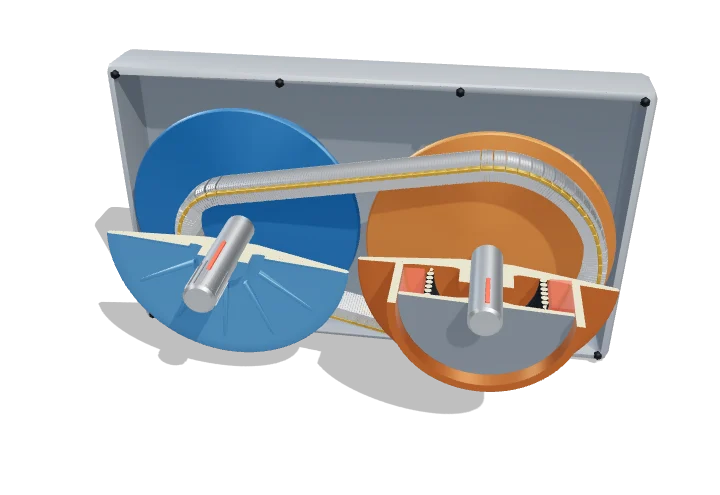
A CVT (continuously variable transmission) uses a steel belt running between two pulleys whose sizes can change. Each pulley is made of two cones; squeezing the cones together pushes the belt outwards so the pulley acts bigger. Making one pulley bigger and the other smaller changes the gear smoothly, with no steps at all.
A belt-type continuously variable transmission changes ratio smoothly by moving one half of each V-shaped pulley along its shaft, so a steel push belt rides at a larger radius on one pulley and a smaller radius on the other. Because any ratio within its range is available, the controller can keep the engine at its most efficient or most powerful speed regardless of road speed.
Key facts
- Ratio range (this model)
- ≈ 2.45 : 1 to 0.41 : 1 (spread ≈ 6)
- Sheave cone half-angle
- ≈ 11°
- Push-belt elements
- ≈ 400, each ≈ 1.5–2 mm thick
- Steel rings
- 2 packs of ≈ 9–12 rings, each ≈ 0.2 mm thick
- Variator efficiency
- ≈ 90–97 % (total with hydraulics lower)
- Torque capacity
- up to ≈ 400 N·m in production cars
Parts you can explore (10)
- Input shaft
- Primary fixed sheave
- Primary movable sheave
- Primary cylinder
- Secondary fixed sheave
- Secondary movable sheave
- Secondary spring and cylinder
- Push belt
- Output shaft
- Housing
In the 3D model
Rotate and take apart the model, follow a guided tour of what each part does and why it’s needed, change it with a live slider, and test yourself with a short quiz. Free, no sign-up.
OpenArc Models’ models are simplified teaching schematics. Terms · Privacy