Cells & molecules
CRISPR–Cas9
Molecular biology · Genome editing
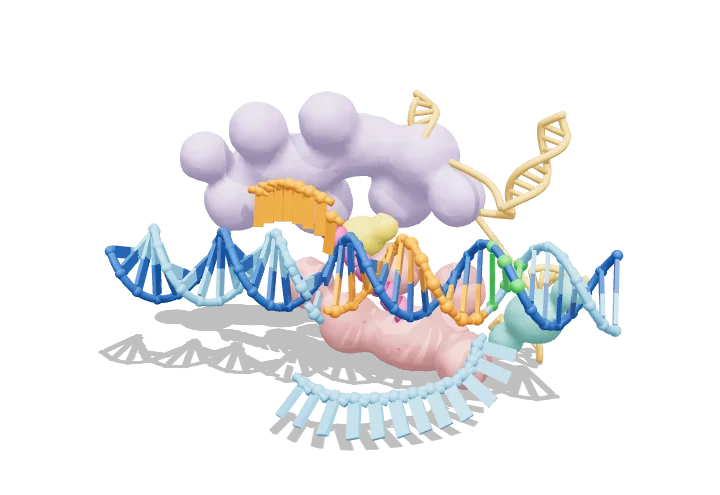 Open the interactive 3D model →
How can a protein find one exact 20-letter sequence in three billion letters of DNA?
Cas9 is a protein that bacteria use to cut up invading viruses. It carries a short piece of RNA — a guide — whose letters match the DNA it should cut. When the guide pairs up perfectly with a matching stretch of DNA, Cas9 snips both strands. Scientists can swap in a guide of their own choosing, which is what makes gene editing possible.
Cas9 is an RNA-guided endonuclease from the bacterial CRISPR immune system that cuts DNA matching the 20-nucleotide spacer of its guide RNA, provided the target sits next to a PAM. Two nuclease domains, HNH and RuvC, each cut one strand to make a double-strand break that cells repair in ways that can be exploited for genome editing.
Key facts
- Enzyme
- SpCas9, 1,368 amino acids (≈ 160 kDa)
- Guide
- sgRNA ≈ 100 nt: 20-nt spacer + scaffold
- PAM (SpCas9)
- 5′-NGG-3′ on the non-target strand, 3′ of the protospacer
- Cut position
- 3 bp upstream (5′) of the PAM; mostly blunt ends
- Seed region
- ≈ 10–12 PAM-proximal nucleotides of the spacer
- Heteroduplex
- 20 bp RNA–DNA hybrid inside the R-loop
Parts you can explore (11)
- Target strand
- Non-target strand
- PAM (NGG)
- Guide RNA spacer
- Guide RNA scaffold
- REC lobe
- RuvC nuclease domain
- HNH nuclease domain
- PAM-interacting domain
- Bridge helix
- Cleavage sites
In the 3D model
Rotate and take apart the model, follow a guided tour of what each part does and why it’s needed, change it with a live slider, and test yourself with a short quiz. Free, no sign-up.
OpenArc Models’ models are simplified teaching schematics. Terms · Privacy