Physics
Coupled pendulums
Mechanics · Normal modes
 Open the interactive 3D model →
If you start just one of two linked pendulums swinging, why does it stop while the other one takes over?
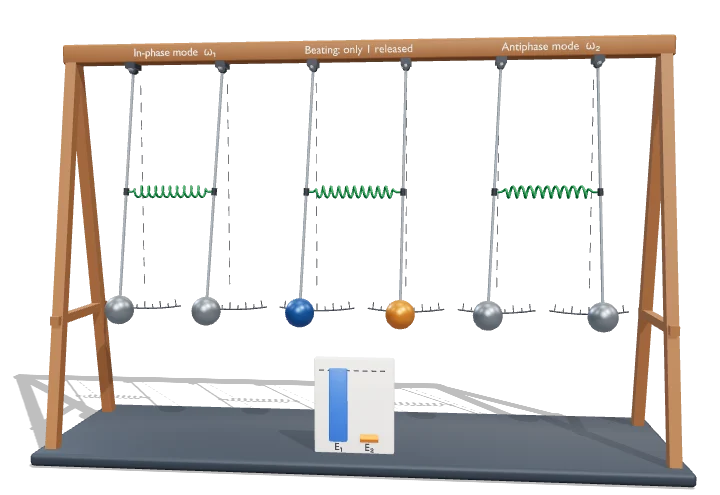
Two pendulums hang side by side, joined by a weak spring. Start one swinging and the spring slowly passes its energy to the other, until the first one stops completely. Then the energy flows back again, over and over.
Two identical pendulums joined by a spring form the simplest system with more than one normal mode: an in-phase mode at the bare pendulum frequency and an antiphase mode raised by the spring. Any other motion is a superposition of these two, so releasing one pendulum alone produces beats in which the energy shuttles completely between them.
Key facts
- Model values
- m = 0.5 kg, L = 1.0 m, spring at d = 0.5 m, A = 0.1 rad
- In-phase mode
- ω₁ = √(g/L) = 3.13 rad/s, T = 2.01 s
- Antiphase mode
- ω₂ = √(g/L + 2kd²/(mL²)); 3.58 rad/s for k = 3 N/m
- Beat period
- T_b = 2π/(ω₂ − ω₁) = 14.1 s for k = 3 N/m
- Complete energy transfer
- every T_b/2 ≈ 7 s for k = 3 N/m
- Number of normal modes
- one per degree of freedom: 2
Parts you can explore (9)
- Support frame
- Pendulum 1
- Pendulum 2
- Coupling spring
- In-phase mode
- Antiphase mode
- Angle scales
- Energy meters
- Mode labels
In the 3D model
Rotate and take apart the model, follow a guided tour of what each part does and why it’s needed, change it with a live slider, and test yourself with a short quiz. Free, no sign-up.
Open Coupled pendulums in 3D →
OpenArc Models’ models are simplified teaching schematics. Terms · Privacy