Plants & animals
Coral polyp
Cnidarians · Reef-building coral
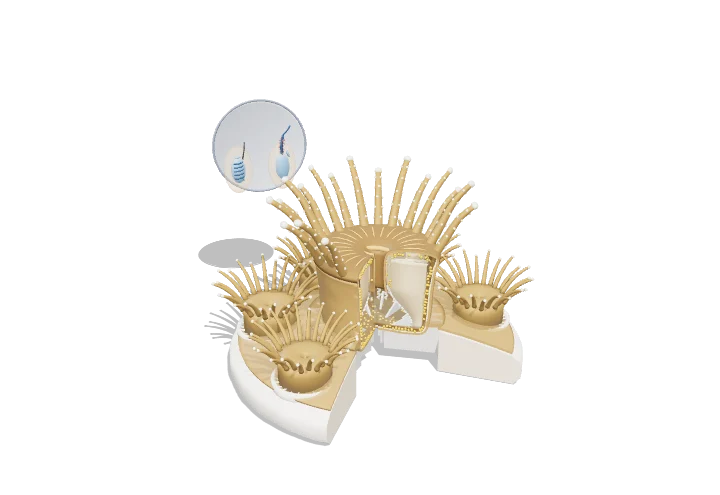 Open the interactive 3D model →
How can an animal smaller than a pea build a reef you can see from space?
A coral is not a rock or a plant: it is a colony of tiny animals called polyps, cousins of jellyfish. Each polyp catches food with stinging tentacles, shelters sun-powered algae inside its body and builds a limestone cup beneath itself. Millions of these cups, stacked over thousands of years, make a reef.
A reef-building coral is a colony of small polyps — animals related to jellyfish — that catch plankton with stinging tentacles, host photosynthetic algae in their tissue and secrete a limestone (aragonite) skeleton beneath themselves. When the water stays too warm for weeks, the partnership breaks down, the algae are expelled and the coral bleaches.
Key facts
- Polyp diameter
- ≈ 1–10 mm in most reef corals; up to several cm in some
- Tentacles
- In multiples of six (hexacorals), commonly 12–48
- Symbiont density
- ≈ 1–5 × 10⁶ algal cells per cm² of coral surface
- Energy from symbionts
- Up to ~90% of the coral’s daily needs in bright, shallow water
- Skeleton
- Aragonite (CaCO₃), laid down at ≈ 0.5–2 cm/yr in massive corals, 10+ cm/yr in fast branching ones
- Bleaching threshold
- Roughly 1 °C above the local summer maximum, sustained for weeks
Parts you can explore (10)
- Tentacles
- Mouth and pharynx
- Body wall
- Gastrovascular cavity
- Mesenteries
- Zooxanthellae
- Corallite
- Coenosarc
- Reef colony
- Nematocyst (inset)
In the 3D model
Rotate and take apart the model, follow a guided tour of what each part does and why it’s needed, change it with a live slider, and test yourself with a short quiz. Free, no sign-up.
OpenArc Models’ models are simplified teaching schematics. Terms · Privacy