Fluids & heat
Cooling tower
Heat transfer · Evaporative cooling
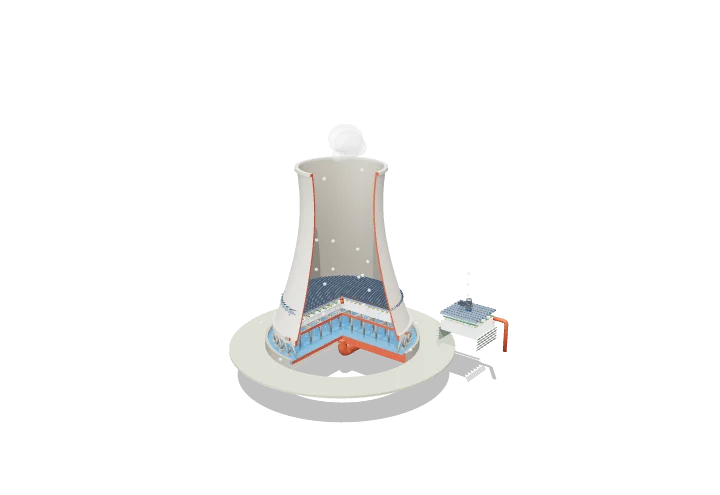 Open the interactive 3D model →
Why do power stations have giant curved towers puffing out white clouds — and is that cloud smoke?
A power station makes a lot of leftover heat, and this tower gets rid of it. Warm water is sprayed inside and rains down through rising air, and a little of it evaporates, carrying most of the heat away. The white cloud on top is just water droplets, like your breath on a cold day.
A wet cooling tower rejects waste heat from a power station or industrial plant by letting warm water fall through rising air, so that a small fraction evaporates and carries most of the heat away. In a natural-draft hyperboloid tower the buoyancy of the warm, moist air inside the tall shell drives the airflow without fans, while smaller mechanical-draft cells use fans instead.
Key facts
- Typical height
- ≈ 120–200 m (natural draft)
- Base diameter
- ≈ 80–120 m
- Range (hot − cold water)
- ≈ 8–12 K
- Approach (cold water − wet bulb)
- ≈ 7–12 K for natural draft
- Evaporation
- ≈ 1.5–2% of circulating flow
- Heat rejected
- ≈ 1.5–2× the electrical output of a steam plant
Parts you can explore (11)
- Shell
- Support columns
- Cold-water basin
- Fill packs
- Hot-water distribution
- Drift eliminators
- Rain zone
- Circulating-water pipes
- Air flow
- Plume
- Mechanical-draft cell
In the 3D model
Rotate and take apart the model, follow a guided tour of what each part does and why it’s needed, change it with a live slider, and test yourself with a short quiz. Free, no sign-up.
OpenArc Models’ models are simplified teaching schematics. Terms · Privacy