Physics
Converging lens
Geometric optics · Thin lenses
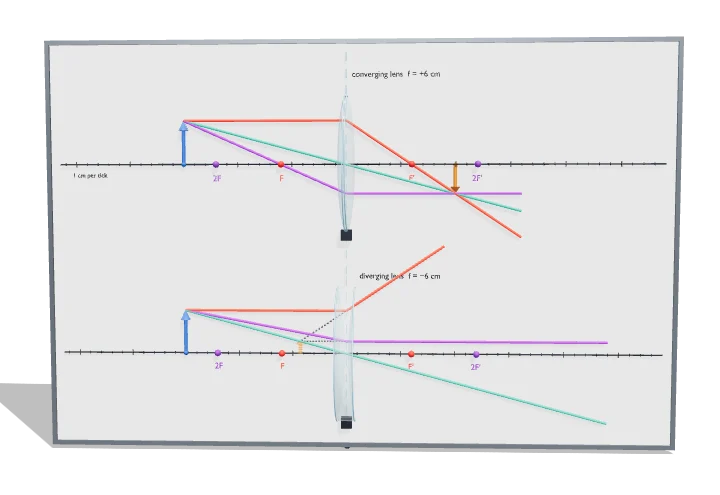 Open the interactive 3D model →
Why does a magnifying glass show things bigger up close, but upside down when you hold it far away?
A converging lens is thicker in the middle and bends light towards a single point called the focus. Where you put an object compared with that focus decides what you see: an upside-down picture you can catch on a screen, or a right-way-up, bigger picture you see by looking through the lens.
A converging lens refracts light so that rays parallel to its axis meet at the focal point, and it forms images whose position and size follow the thin-lens equation 1/u + 1/v = 1/f. Depending on where the object is, the image is real and inverted or, inside the focal length, virtual, upright and magnified.
Key facts
- Thin-lens equation
- 1/u + 1/v = 1/f (real-is-positive)
- Magnification
- m = −v/u
- Model focal length
- +6 cm (converging), −6 cm (diverging)
- Lens power
- P = 1/f; f = 6 cm → 16.7 D
- Object at 2F
- Image at 2F′, same size, inverted
- Model scale
- 1 unit = 10 cm; 1 tick = 1 cm
Parts you can explore (11)
- Converging lens
- Principal axis
- Focal points
- Object
- Image
- Parallel ray
- Central ray
- Focal ray
- Virtual ray extensions
- Diverging lens comparison
- Optics board
In the 3D model
Rotate and take apart the model, follow a guided tour of what each part does and why it’s needed, change it with a live slider, and test yourself with a short quiz. Free, no sign-up.
OpenArc Models’ models are simplified teaching schematics. Terms · Privacy