Physics
Conical pendulum
Mechanics · Circular motion
 Open the interactive 3D model →
Why do the chairs on a spinning fairground ride swing outwards, and further the faster it spins?
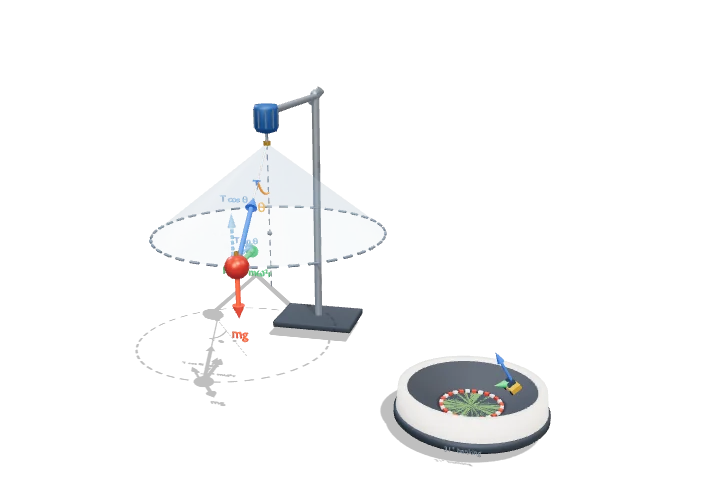
Whirl a weight on a string and the string sweeps out a cone. Only two forces act on the weight: the string pulling and gravity pulling down. Together they make a sideways push towards the centre that keeps the weight going round in a circle — and the faster it spins, the flatter the cone.
A conical pendulum is a bob moving at constant speed on a horizontal circle while its string sweeps out a cone; the vertical component of the tension balances the weight and the horizontal component provides the centripetal force. Combining the two gives tan θ = ω²r/g (equivalently cos θ = g/ω²L), the same relation that sets the design speed of a banked curve.
Key facts
- Cone angle
- cos θ = g / (ω²L), equivalently tan θ = ω²r/g
- Tension
- T = mg / cos θ
- Centripetal force
- F_c = mg tan θ = mω²r
- Period
- T_p = 2π√(L cos θ / g)
- Minimum rotation rate
- ω_min = √(g/L) = 3.13 rad/s for L = 1.0 m
- Model at ω = 4.0 rad/s
- θ ≈ 52°, r ≈ 0.79 m, T ≈ 3.2 N, period 1.57 s
Parts you can explore (14)
- Support stand
- Pivot and motor
- String
- Bob
- Circular path
- Swept cone
- Tension T
- Weight mg
- Centripetal force
- Tension components
- Cone angle θ
- Banked curve
- Car on banked curve
- Car force vectors
In the 3D model
Rotate and take apart the model, follow a guided tour of what each part does and why it’s needed, change it with a live slider, and test yourself with a short quiz. Free, no sign-up.
OpenArc Models’ models are simplified teaching schematics. Terms · Privacy