Power & energy
Concentrated solar power tower
Renewable energy · Solar thermal
 Open the interactive 3D model →
Can a solar power station keep making electricity after the Sun goes down?
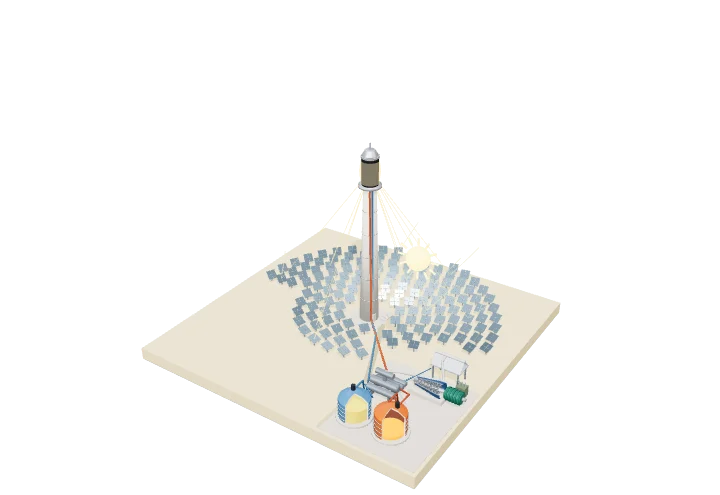
Thousands of mirrors on the ground tilt to bounce sunlight onto one spot at the top of a tall tower. The light there is so intense that it heats a liquid salt to over 500 °C, and the hot salt is kept in a big insulated tank. When electricity is needed, even at night, the hot salt boils water and the steam spins a turbine.
A solar power tower uses thousands of sun-tracking mirrors (heliostats) to concentrate sunlight onto a receiver, where it heats molten nitrate salt from about 290 °C to 565 °C. The hot salt is stored in an insulated tank and used on demand to raise steam for a conventional turbine, so the plant can generate electricity for many hours after sunset.
Key facts
- Example plant
- Gemasolar (Spain): 19.9 MWe, ≈ 2,650 heliostats, 140 m tower, 15 h storage
- Salt temperatures
- Cold ≈ 290 °C, hot ≈ 565 °C
- Solar salt
- 60% NaNO₃ + 40% KNO₃ by mass, freezes ≈ 220 °C
- Concentration ratio
- ≈ 500–1,000 suns at the receiver
- Design DNI
- ≈ 850–1,000 W/m² at noon on clear days
- Annual solar-to-electric efficiency
- ≈ 15–18%
Parts you can explore (11)
- Heliostat field
- Tower
- Receiver
- Hot salt tank
- Cold salt tank
- Steam generator
- Steam turbine and generator
- Air-cooled condenser
- Salt piping and pumps
- Sun and rays
- Site and ground
In the 3D model
Rotate and take apart the model, follow a guided tour of what each part does and why it’s needed, change it with a live slider, and test yourself with a short quiz. Free, no sign-up.
Open Concentrated solar power tower in 3D →
OpenArc Models’ models are simplified teaching schematics. Terms · Privacy