Astronomy & space
Comet
Planetary science · Small bodies
 Open the interactive 3D model →
Why does a comet grow a tail millions of kilometres long — and why does the tail point away from the Sun?
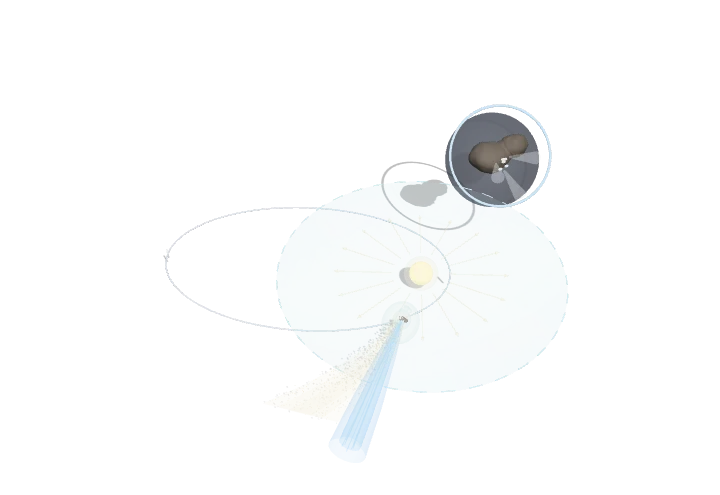
A comet is a lump of ice and dust only a few kilometres across that spends most of its time far from the Sun, frozen and dark. When its long, stretched orbit brings it close to the Sun, the ice turns straight into gas and blows dust off, making a huge glowing cloud. Sunlight and the solar wind push this gas and dust away from the Sun, forming two tails.
A comet is a kilometre-sized body of ice and dust that becomes active as its eccentric orbit brings it close to the Sun, when sublimating ices release gas and dust into a vast coma. Sunlight pushes the dust into a curved, yellowish tail, while the solar wind sweeps ionised gas into a straight, bluish tail pointing directly away from the Sun.
Key facts
- Nucleus size
- typically ~1–20 km
- Nucleus albedo
- ≈ 2–6 % (darker than coal)
- Coma diameter
- ≈ 10⁴–10⁵ km
- Tail length
- up to ~10⁸ km (≈ 1 AU)
- Water sublimation onset
- within ≈ 3 AU of the Sun
- Example: 67P/Churyumov–Gerasimenko
- 4.1 × 3.3 × 1.8 km; 6.4-yr orbit
Parts you can explore (10)
- Sun
- Solar wind
- Orbit
- Water-ice sublimation zone
- Nucleus
- Coma
- Gas jets
- Ion tail
- Dust tail
- Nucleus close-up
In the 3D model
Rotate and take apart the model, follow a guided tour of what each part does and why it’s needed, change it with a live slider, and test yourself with a short quiz. Free, no sign-up.
OpenArc Models’ models are simplified teaching schematics. Terms · Privacy