Power & energy
Combined-cycle power plant
Power generation · Brayton + Rankine
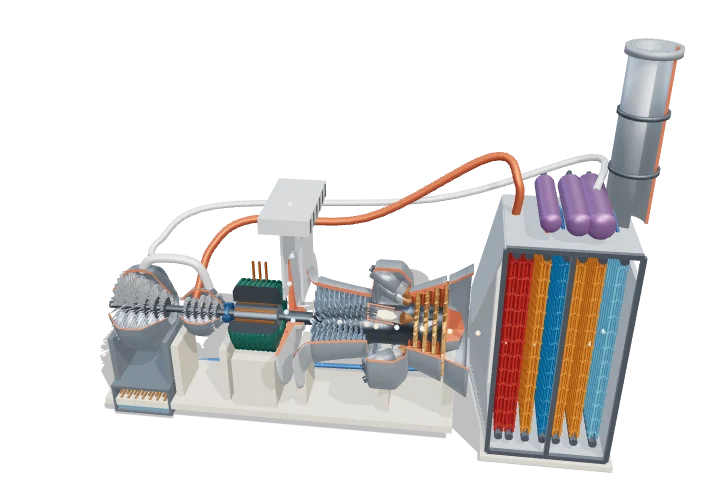 Open the interactive 3D model →
How can a power station get a second helping of electricity from the same fuel?
A combined-cycle plant first burns natural gas in a gas turbine, a machine like a jet engine, which spins a generator. Its exhaust is still hotter than a pizza oven, so instead of wasting it the plant uses it to boil water, and that steam spins a second turbine. Together they turn about 60% of the fuel’s energy into electricity, far more than older power stations manage.
A combined-cycle plant puts a steam (Rankine) cycle underneath a gas-turbine (Brayton) cycle, using the gas turbine’s hot exhaust to raise steam in a heat-recovery steam generator. Because the second cycle needs no extra fuel, modern plants convert about 60 % of the fuel energy into electricity — the highest of any large thermal power station.
Key facts
- Net efficiency (new H class)
- ≈ 60–64 % (LHV)
- Typical unit size
- ≈ 400–1300 MW per block
- Output split
- ≈ 2/3 gas turbine, 1/3 steam turbine
- GT exhaust / stack temperature
- ≈ 600–650 °C / ≈ 80–100 °C
- HP steam conditions
- ≈ 16–18 MPa, ≈ 585–600 °C (with reheat)
- CO₂ intensity (natural gas)
- ≈ 330–370 kg per MWh
Parts you can explore (15)
- Compressor
- Combustors
- Gas turbine
- Generator
- Steam turbine
- Condenser
- HRSG casing
- Superheaters
- Evaporators
- Economisers
- Steam drums
- Stack
- Steam piping
- Gas flow
- Steam & water flow
In the 3D model
Rotate and take apart the model, follow a guided tour of what each part does and why it’s needed, change it with a live slider, and test yourself with a short quiz. Free, no sign-up.
Open Combined-cycle power plant in 3D →
OpenArc Models’ models are simplified teaching schematics. Terms · Privacy