Power & energy
Coal-fired power plant
Power generation · Rankine cycle
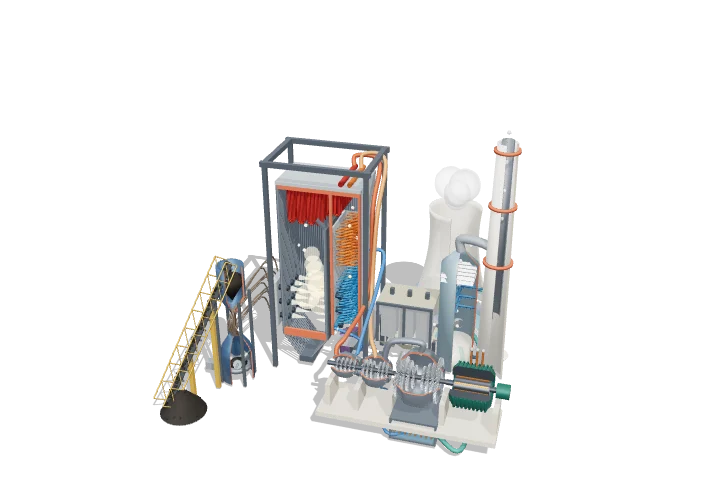 Open the interactive 3D model →
Why does a coal power station throw away more than half the energy in its coal?
A coal power station burns powdered coal to boil water into very hot, high-pressure steam. The steam spins turbines that turn a generator and make electricity. Afterwards the steam must be cooled back into water, and that cooling carries away more than half of the coal’s energy as warm water and vapour.
A pulverised-coal plant burns finely ground coal in a furnace whose walls are water-filled tubes, and uses the steam in a reheat Rankine cycle to drive HP, IP and LP turbines and a generator. Even the best units convert only about 45 % of the coal’s energy to electricity, so they reject more heat than they deliver and emit roughly 750–1000 kg of CO₂ per megawatt-hour.
Key facts
- Unit size
- ≈ 300–1100 MWe
- Net efficiency
- ≈ 33–38 % subcritical, ≈ 42–47 % ultra-supercritical (LHV)
- Main steam (ultra-supercritical)
- ≈ 25–30 MPa, ≈ 600–620 °C
- Coal burned (800 MW unit)
- ≈ 250–300 t per hour
- CO₂ intensity
- ≈ 750–1000 kg per MWh
- Furnace gas temperature
- ≈ 1300–1600 °C
Parts you can explore (16)
- Coal conveyor
- Pulveriser mill
- Burners
- Water walls
- Superheater & reheater
- Economiser & air heater
- Steam turbines
- Generator
- Condenser
- Feedwater & steam piping
- Electrostatic precipitator
- Flue-gas desulphurisation
- Chimney
- Cooling tower
- Flue gas flow
- Steam & water flow
In the 3D model
Rotate and take apart the model, follow a guided tour of what each part does and why it’s needed, change it with a live slider, and test yourself with a short quiz. Free, no sign-up.
Open Coal-fired power plant in 3D →
OpenArc Models’ models are simplified teaching schematics. Terms · Privacy