Electromagnetism & electronics
CMOS image sensor
Electronics · Imaging
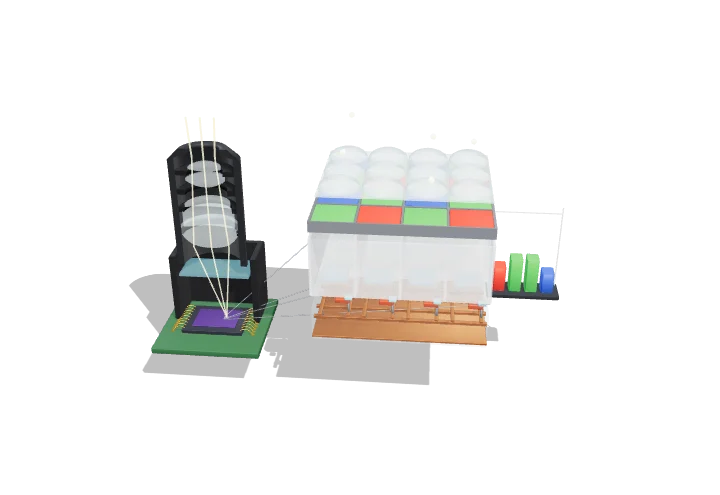 Open the interactive 3D model →
How does your phone turn light into a photo made of 50 million numbers?
Behind your phone’s camera lens is a silicon chip covered in millions of tiny light buckets called pixels. When light hits a pixel it knocks loose electrons, and the brighter the light, the more electrons pile up. Each pixel’s pile is counted and turned into a number, and coloured filters on top let the phone work out the colours.
A CMOS image sensor is a silicon chip carrying millions of pixels, each a photodiode that converts absorbed photons into electrons and stores them during an exposure. At the end of the exposure each pixel’s charge is transferred, converted to a voltage and digitised, while a mosaic of colour filters lets a single-chip camera reconstruct a full-colour image.
Key facts
- Pixel pitch, smartphone main camera
- ≈ 0.6–2.4 µm
- Full-well capacity (≈ 1 µm pixel)
- ≈ 4,000–10,000 electrons
- Peak quantum efficiency (BSI)
- ≈ 70–90 % at green wavelengths
- Read noise, modern sensor
- ≈ 1–3 electrons rms
- Silicon band gap
- 1.12 eV → cut-off ≈ 1100 nm
- Pixels in a 50-megapixel sensor
- ≈ 5 × 10⁷
Parts you can explore (12)
- Module substrate and die
- Lens holder and barrel
- Lens stack
- IR-cut filter
- Incoming light
- Microlens array
- Bayer colour filter
- Photodiodes
- Photo-electrons
- Transfer gates
- Readout circuitry
- Pixel values
In the 3D model
Rotate and take apart the model, follow a guided tour of what each part does and why it’s needed, change it with a live slider, and test yourself with a short quiz. Free, no sign-up.
Open CMOS image sensor in 3D →
OpenArc Models’ models are simplified teaching schematics. Terms · Privacy