Mechanisms
Single-plate dry clutch
Mechanisms · Automotive drivetrain
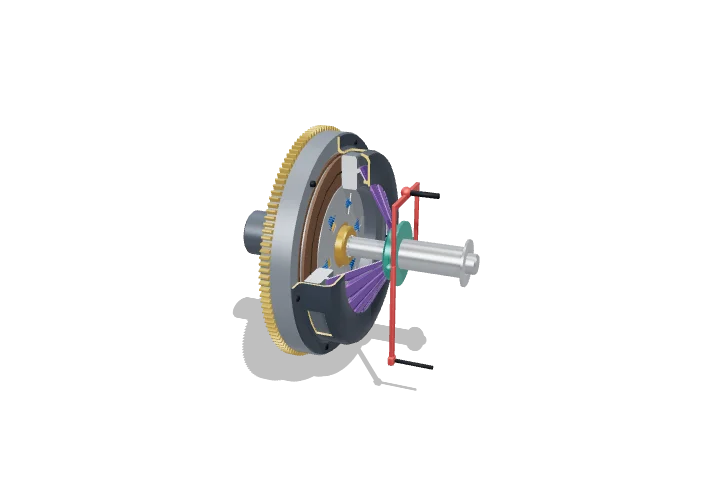 Open the interactive 3D model →
How can a car’s engine keep running while the wheels stand completely still?
A car’s clutch sits between the engine and the gearbox. A strong spring squeezes a disc between two spinning metal plates, so the engine’s turning is passed on by friction. Pressing the clutch pedal pulls the plates apart, so the engine can spin while the gearbox and wheels stop.
A single-plate dry clutch couples the engine to the gearbox by clamping a friction disc between the flywheel and a spring-loaded pressure plate, so the torque it can carry is set by the clamp force, the friction coefficient and the mean radius of the linings. Pressing the pedal pushes a release bearing against the fingers of a diaphragm spring, which levers the pressure plate away and lets the disc slip or run free.
Key facts
- Torque capacity (uniform wear)
- T = n μ F (r_o + r_i)/2
- Friction faces on a single-plate clutch
- n = 2
- Lining friction coefficient
- μ ≈ 0.25–0.4 (organic), ≈ 0.3 typical
- Clamp load, passenger car
- ≈ 3–9 kN
- Diaphragm lever ratio
- ≈ 3.5–5 : 1 (≈ 4 : 1 here)
- Pressure-plate lift when released
- ≈ 1.5–2 mm
Parts you can explore (12)
- Crankshaft flange
- Flywheel
- Starter ring gear
- Friction disc
- Torsional damper springs
- Splined hub
- Pressure plate
- Diaphragm spring
- Clutch cover
- Release bearing
- Release fork
- Input shaft
In the 3D model
Rotate and take apart the model, follow a guided tour of what each part does and why it’s needed, change it with a live slider, and test yourself with a short quiz. Free, no sign-up.
Open Single-plate dry clutch in 3D →
OpenArc Models’ models are simplified teaching schematics. Terms · Privacy