Physics
Diffusion cloud chamber
Particle physics · Detectors
 Open the interactive 3D model →
Invisible particles are zipping through you right now — how can you actually see their trails?
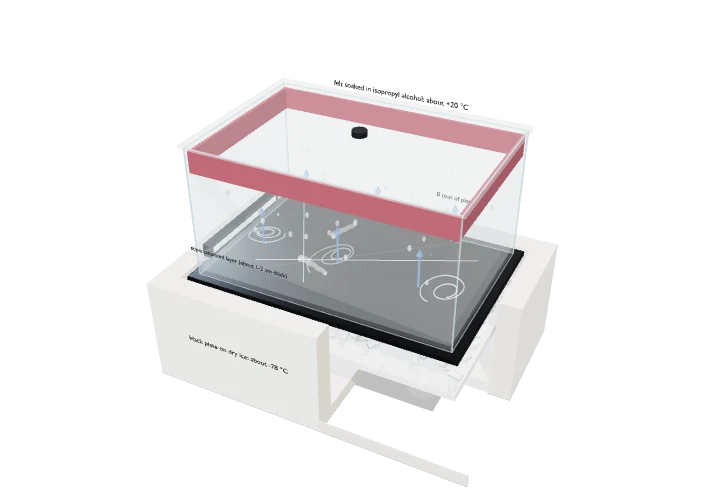
Radiation and particles from space pass through us all the time, too small to see. A cloud chamber fills a tank with a cold mist that is just about to turn into droplets. When a particle zooms through, droplets form along its path, leaving a short-lived trail like the white line behind a jet plane.
A diffusion cloud chamber makes the paths of invisible charged particles visible: alcohol vapour diffusing from a warm top to a plate at −78 °C becomes supersaturated, and the ions a particle leaves behind seed lines of droplets. Track shape reveals the particle — short and thick for alphas, thin and wandering for betas, long and straight for cosmic muons — and a magnetic field adds momentum and charge sign.
Key facts
- Cold plate temperature
- ≈ −78 °C (dry ice sublimes at −78.5 °C)
- Working fluid
- isopropyl alcohol (≥ 99%) evaporating from felt at room temperature
- Sensitive layer
- ≈ 1–2 cm thick, just above the plate
- Alpha track length in air
- ≈ 3.5–7 cm (4–8 MeV alphas)
- Cosmic muon flux at sea level
- ≈ 1 per cm² per minute (horizontal surface)
- Track lifetime
- ≈ 1–2 s before the droplets fall and diffuse
Parts you can explore (13)
- Glass tank
- Lid
- Alcohol-soaked felt
- Alcohol vapour
- Supersaturated layer
- Cold plate
- Dry ice
- Insulated box
- Light source
- Alpha tracks
- Beta tracks
- Muon tracks
- Magnet
In the 3D model
Rotate and take apart the model, follow a guided tour of what each part does and why it’s needed, change it with a live slider, and test yourself with a short quiz. Free, no sign-up.
Open Diffusion cloud chamber in 3D →
OpenArc Models’ models are simplified teaching schematics. Terms · Privacy