Mechanisms
Pendulum clock escapement
Mechanisms · Horology
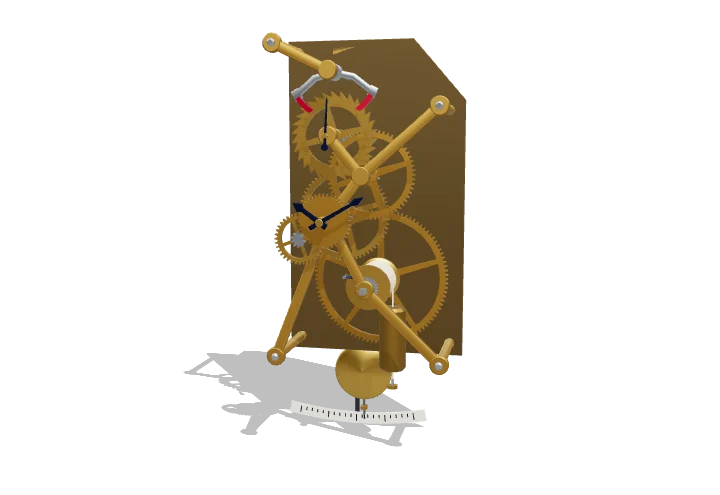 Open the interactive 3D model →
How does a swinging weight on a stick keep a clock accurate to a few seconds a week?
A pendulum swings back and forth in almost exactly the same time, every time. A falling weight tries to spin the clock’s gears, and a clever catch called the escapement lets the gears move only one small step per swing. Each step moves the hands forward and gives the pendulum a tiny push so it never stops.
A pendulum clock is an oscillator (the pendulum), an energy source (a falling weight) and a counter (the gear train), linked by an escapement that releases the train one step per beat and gives the pendulum a small push to keep it swinging. In George Graham’s deadbeat escapement the escape wheel is locked motionless except during a brief impulse near the centre of each swing, so the pendulum’s natural period T = 2π√(L/g) sets the rate.
Key facts
- Seconds pendulum length
- L = g/π² ≈ 0.994 m (T = 2 s, one beat per second)
- Escape wheel
- 30 teeth → 1 rev/min; ½ tooth per beat
- Train ratio escape → centre
- 60 : 1 (64/8 × 60/8)
- Typical regulator amplitude
- ≈ 1.5–2° either side of vertical
- Length sensitivity
- 1 s/day ↔ ≈ 23 µm change in L
- Steel-rod temperature error
- ≈ 0.5 s/day per °C
Parts you can explore (12)
- Escape wheel
- Anchor
- Pallets
- Crutch
- Pendulum
- Suspension spring
- Going train
- Great wheel and barrel
- Weight and cord
- Motion work and hands
- Plates and pillars
- Beat scale
In the 3D model
Rotate and take apart the model, follow a guided tour of what each part does and why it’s needed, change it with a live slider, and test yourself with a short quiz. Free, no sign-up.
Open Pendulum clock escapement in 3D →
OpenArc Models’ models are simplified teaching schematics. Terms · Privacy