Human body
Circulatory system
Anatomy · Cardiovascular system
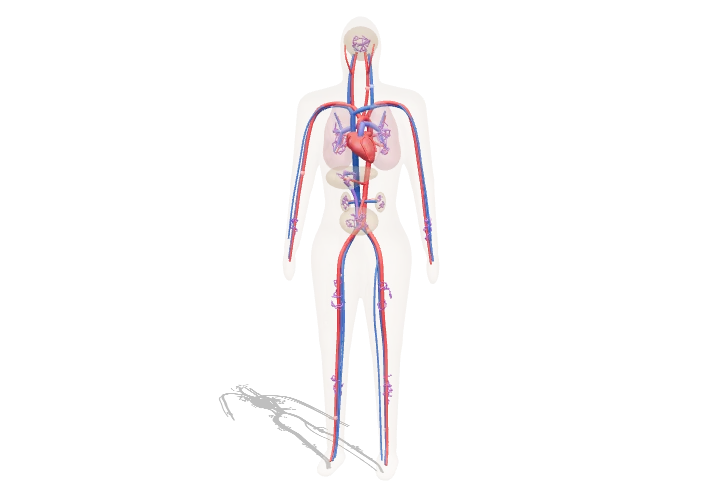 Open the interactive 3D model →
How long does it take a drop of your blood to travel all the way round your body and back?
Your heart is two pumps side by side. The right side sends blood to the lungs to pick up oxygen, and the left side sends that oxygen-rich blood out through arteries to every part of the body. Tiny capillaries hand the oxygen to your cells, and veins bring the blood back — at rest, the whole trip takes about a minute.
The circulatory system is a closed double circuit in which the heart pumps blood through arteries, capillaries and veins to every tissue and through the lungs. Cardiac output — heart rate times stroke volume — sets how fast the whole blood volume circulates, about once a minute at rest.
Key facts
- Blood volume, adult
- ≈ 5 L (≈ 70 mL/kg)
- Resting cardiac output
- ≈ 5 L/min (HR ≈ 70 bpm × SV ≈ 70 mL)
- Maximal cardiac output
- ≈ 20–25 L/min (≈ 35–40 L/min in elite endurance athletes)
- Arterial pressure, resting
- ≈ 120/80 mmHg (mean ≈ 93 mmHg)
- Distribution of blood volume
- ≈ 64% veins, 13% arteries, 7% capillaries, 9% pulmonary, 7% heart
- Capillary diameter
- ≈ 5–10 µm
Parts you can explore (12)
- Body outline
- Heart
- Aorta
- Major arteries
- Venae cavae
- Major veins
- Pulmonary arteries
- Pulmonary veins
- Lungs
- Capillary beds
- Organs
- Blood flow
In the 3D model
Rotate and take apart the model, follow a guided tour of what each part does and why it’s needed, change it with a live slider, and test yourself with a short quiz. Free, no sign-up.
Open Circulatory system in 3D →
OpenArc Models’ models are simplified teaching schematics. Terms · Privacy