Electromagnetism & electronics
Miniature circuit breaker
Electrical safety · Protection
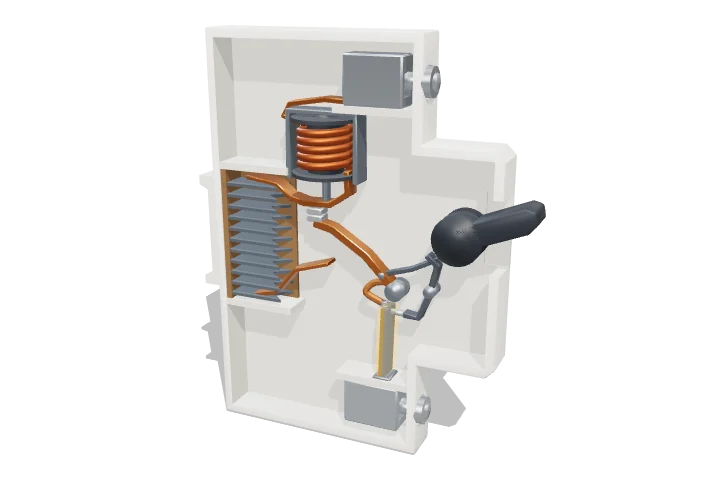 Open the interactive 3D model →
How does a little switch in your fuse box know the difference between a kettle and a short circuit?
A circuit breaker is a switch that turns itself off when too much current flows, before the wires can overheat and start a fire. It has two detectors: a metal strip that slowly bends when a small overload warms it, and an electromagnet that snaps it open in a few thousandths of a second when there is a short circuit. Then a spring throws the contacts apart and a stack of steel plates puts out the spark.
A miniature circuit breaker (MCB) protects a circuit with two trip mechanisms in series with the load: a bimetal strip that bends when an overload heats it, giving a delay that shortens as the current rises, and a solenoid that trips the breaker within milliseconds on a short circuit. A spring-loaded, trip-free mechanism throws the contacts apart, and an arc chute of steel splitter plates extinguishes the arc.
Key facts
- Rated currents
- ≈ 6–63 A for household and commercial MCBs
- Thermal test points (IEC 60898-1)
- No trip at 1.13 × In within 1 h; trip at 1.45 × In within 1 h
- Magnetic trip bands
- Type B 3–5 × In, type C 5–10 × In, type D 10–20 × In
- Magnetic trip time
- < 0.1 s by standard; typically ≈ 3–10 ms
- Breaking capacity
- Typically 6 kA or 10 kA at 230/400 V
- Module width
- 17.5–18 mm per pole on 35 mm DIN rail
Parts you can explore (9)
- Moulded case
- Terminals
- Magnetic trip coil
- Fixed contact
- Moving contact
- Arc chute
- Bimetal strip
- Trip latch
- Toggle handle
In the 3D model
Rotate and take apart the model, follow a guided tour of what each part does and why it’s needed, change it with a live slider, and test yourself with a short quiz. Free, no sign-up.
Open Miniature circuit breaker in 3D →
OpenArc Models’ models are simplified teaching schematics. Terms · Privacy