Cells & molecules
Motile cilium and axoneme
Cell biology · Cytoskeleton
 Open the interactive 3D model →
What keeps the dust you breathe in from piling up in your lungs?
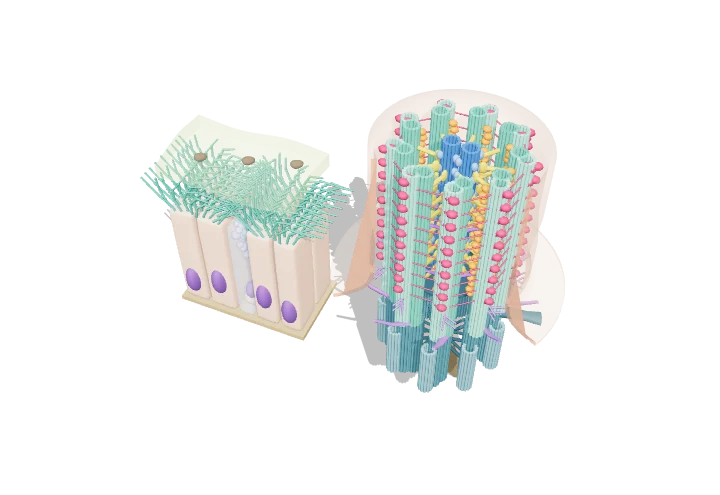
Your airways are lined with cells covered in hundreds of tiny hairs called cilia, each beating 10–15 times a second. Together they sweep a sticky layer of mucus, with trapped dust and germs, up towards your throat. Inside each cilium, rows of tiny motor proteins make tubes slide past each other, and that sliding bends the hair.
A motile cilium is a membrane-bound whip driven by a 9+2 axoneme in which dynein motors slide neighbouring doublet microtubules past one another. Because the doublets are tied together and anchored in a basal body, that sliding becomes a rhythmic bend that, in the airway, sweeps a mucus blanket toward the throat.
Key facts
- Axoneme diameter
- ≈ 200 nm (cilium ≈ 250 nm with membrane)
- Airway cilium length
- ≈ 6–7 µm
- Cilia per airway cell
- ≈ 200–300
- Beat frequency (human airway)
- ≈ 10–15 Hz at body temperature
- Outer-arm repeat
- 24 nm; spokes and inner arms repeat every 96 nm
- Basal body
- 9 triplet microtubules, ≈ 500 nm long
Parts you can explore (12)
- Doublet microtubules
- Central pair
- Outer dynein arms
- Inner dynein arms
- Radial spokes
- Nexin links
- Ciliary membrane
- Transition zone
- Basal body
- Ciliated epithelium
- Beating cilia
- Mucus layer
In the 3D model
Rotate and take apart the model, follow a guided tour of what each part does and why it’s needed, change it with a live slider, and test yourself with a short quiz. Free, no sign-up.
Open Motile cilium and axoneme in 3D →
OpenArc Models’ models are simplified teaching schematics. Terms · Privacy