Cells & molecules
Chromosome packaging
Molecular biology · Chromatin
 Open the interactive 3D model →
How do you fit two metres of DNA into a nucleus a few thousandths of a millimetre across?
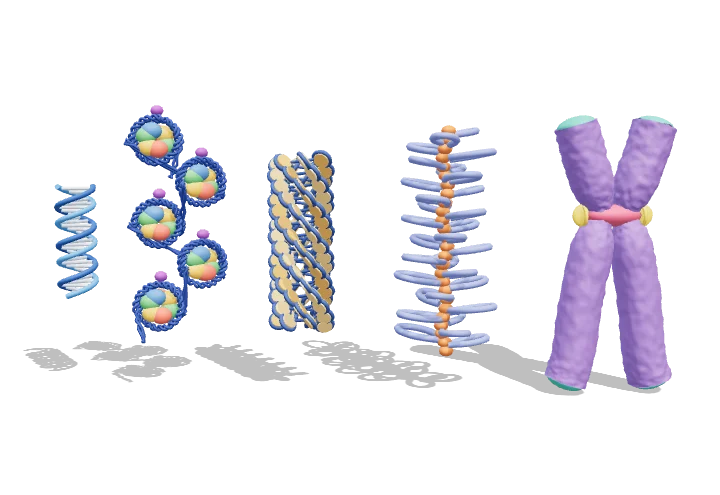
Each of your cells holds about 2 m of DNA, yet the nucleus is only about 6 µm wide. The cell packs it in layers: the DNA wraps around protein spools, the spools coil up, and the coils fold into loops. Before a cell divides it packs everything even tighter into the X-shaped chromosomes you see in textbooks.
Eukaryotic DNA is packed into chromatin through a hierarchy of folding: DNA winds around histone octamers to form nucleosomes, nucleosome chains fold further, and loops anchored by protein complexes compact it into chromosomes. Each level shortens the DNA, reaching about 10,000-fold compaction in a metaphase chromosome, while still allowing regulated access to genes.
Key facts
- DNA per human diploid nucleus
- ≈ 6.4 × 10⁹ bp ≈ 2 m
- Nucleosome core
- 147 bp in ≈ 1.65 left-handed turns
- Nucleosome repeat length
- ≈ 160–240 bp (≈ 200 bp typical)
- Nucleosomes per diploid human nucleus
- ≈ 3 × 10⁷
- Metaphase chromatid width
- ≈ 0.7 µm (chromosome ≈ 1.4 µm)
- Overall compaction in mitosis
- ≈ 10,000-fold
Parts you can explore (11)
- DNA double helix
- Histone octamers
- Nucleosomal DNA
- Linker histone H1
- 30-nm fibre
- Chromatin loops
- Protein scaffold
- Sister chromatids
- Centromere
- Kinetochores
- Telomeres
In the 3D model
Rotate and take apart the model, follow a guided tour of what each part does and why it’s needed, change it with a live slider, and test yourself with a short quiz. Free, no sign-up.
Open Chromosome packaging in 3D →
OpenArc Models’ models are simplified teaching schematics. Terms · Privacy