Chemistry
Chromatography: TLC, column and HPLC
Analytical chemistry · Separation
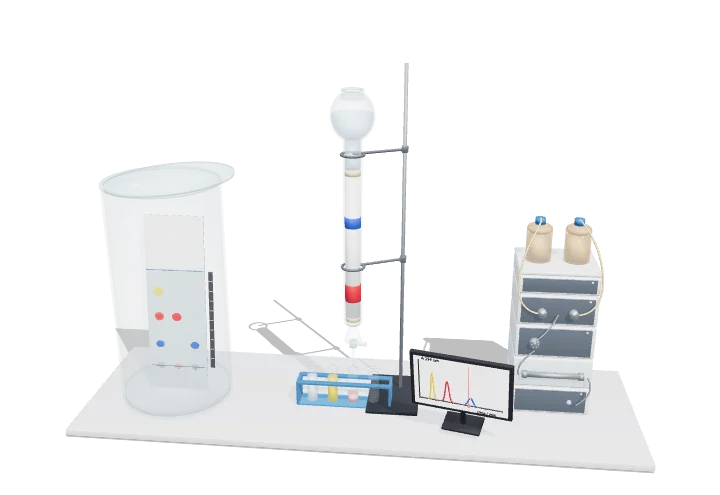 Open the interactive 3D model →
How can a strip of coated plastic and a little solvent pull apart the colours hidden in a single drop of ink?
Chromatography separates a mixture by letting a liquid (the solvent) carry it past a solid that tries to hold each substance back. Substances that cling to the solid move slowly, while those that prefer the liquid race ahead, so the mixture spreads out into separate spots or bands. The same idea works on a small plate, in a glass column or in a high-pressure HPLC machine.
Chromatography separates the components of a mixture by letting a mobile phase carry them past a stationary phase that holds each one back to a different extent. The same partition principle underlies a thin-layer plate, a gravity column and a high-pressure HPLC instrument; only the scale, particle size and detection differ.
Key facts
- Retardation factor
- Rf = spot distance ÷ front distance, 0 ≤ Rf ≤ 1
- Typical TLC plate
- silica layer ≈ 0.20–0.25 mm on glass or aluminium
- Flash-column silica
- 40–63 µm particles
- HPLC particles
- 1.7–5 µm; pressures ≈ 50–400 bar (UHPLC up to ~1,000+ bar)
- Analytical HPLC flow
- ≈ 0.2–2 mL min⁻¹ through a 4.6 mm × 150 mm column
- Plate number (5 µm, 15 cm)
- N ≈ 10,000–15,000
Parts you can explore (15)
- Developing chamber
- Mobile phase
- TLC plate
- Baseline & sample lanes
- Solvent front
- Separated spots
- Rf gauge
- Glass column
- Silica gel bed
- Coloured bands
- Fraction tubes
- HPLC pump & solvents
- Injector & HPLC column
- Detector & chromatogram
- Bench
In the 3D model
Rotate and take apart the model, follow a guided tour of what each part does and why it’s needed, change it with a live slider, and test yourself with a short quiz. Free, no sign-up.
Open Chromatography: TLC, column and HPLC in 3D →
OpenArc Models’ models are simplified teaching schematics. Terms · Privacy