Cells & molecules
Chloroplast
Cell biology · Organelle
 Open the interactive 3D model →
How does a leaf turn sunlight, water and air into sugar — and where does the oxygen come from?
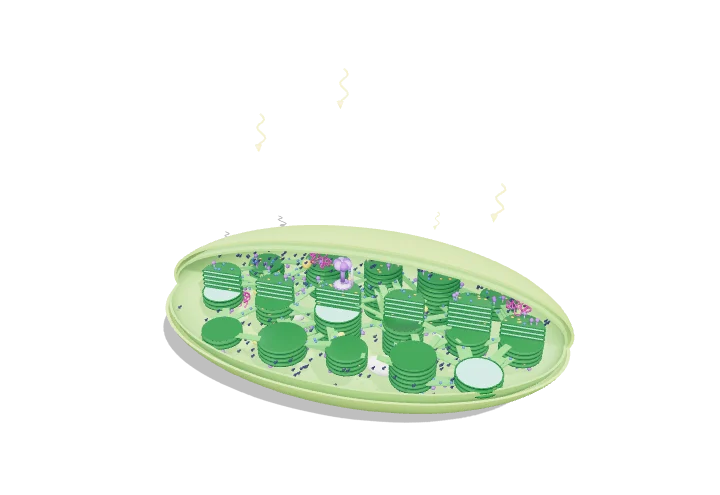
Chloroplasts are the tiny green parts of plant cells that run photosynthesis. Inside, stacks of green membrane discs catch sunlight and use its energy to split water, which releases the oxygen we breathe. The captured energy is then used in the surrounding fluid to build sugar from carbon dioxide taken from the air.
Chloroplasts capture light energy in the thylakoid membranes and store it as ATP and NADPH, releasing O₂ from water. In the surrounding stroma, the Calvin cycle spends that ATP and NADPH to fix CO₂ into sugar.
Key facts
- Size
- ≈ 5–10 µm long, 2–4 µm thick (lens-shaped)
- Per leaf mesophyll cell
- ≈ 20–100 chloroplasts
- Grana
- ≈ 10–20 thylakoids per stack, ≈ 300–600 nm across
- Chloroplast genome
- ≈ 120–160 kb circular; ≈ 100–130 genes
- Lumen pH in light
- ≈ 5.8–6.5 (stroma ≈ 7.8–8)
- ATP synthase c-ring
- 14 subunits in spinach ⇒ ≈ 4.7 H⁺ per ATP
Parts you can explore (13)
- Outer membrane
- Inner membrane
- Stroma
- Grana
- Thylakoid lumen
- Stroma lamellae
- Photosystems
- ATP synthase
- Starch grains
- Plastoglobuli
- cpDNA
- Ribosomes
- Sunlight
In the 3D model
Rotate and take apart the model, follow a guided tour of what each part does and why it’s needed, change it with a live slider, and test yourself with a short quiz. Free, no sign-up.
OpenArc Models’ models are simplified teaching schematics. Terms · Privacy