Chemistry
Chirality and enantiomers
Organic chemistry · Stereochemistry
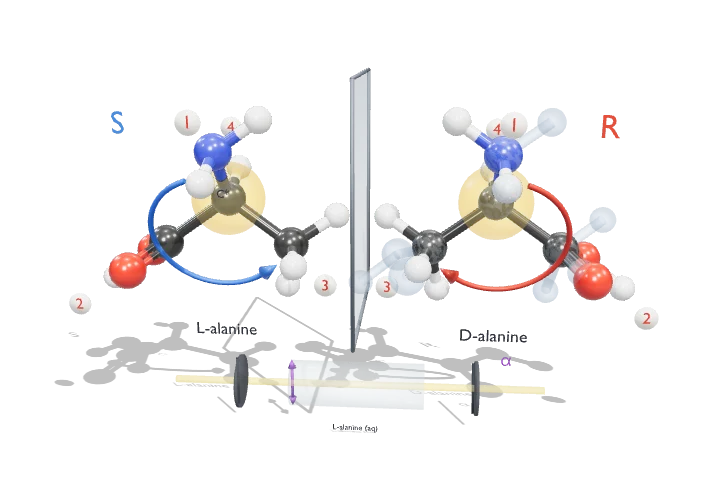 Open the interactive 3D model →
Why can two molecules made of exactly the same atoms smell different, or act as a medicine versus a dud?
Some molecules come in a left-handed and a right-handed version, like your hands: mirror images that can never be stacked perfectly on top of each other. This happens when a carbon atom holds four different groups. The two versions behave the same in most tests, but living things, which are themselves “handed”, can tell them apart.
A molecule is chiral when it cannot be superimposed on its mirror image; the commonest cause is a stereocentre, a tetrahedral carbon bearing four different groups, as in the α carbon of alanine. The two mirror-image forms (enantiomers) are labelled R or S by the Cahn–Ingold–Prelog rules; they share almost all physical properties but rotate plane-polarised light in opposite directions and interact differently with other chiral molecules such as enzymes.
Key facts
- Stereocentre
- Cα of alanine: NH₂, COOH, CH₃, H
- CIP priorities
- NH₂ (1) > COOH (2) > CH₃ (3) > H (4)
- L-alanine
- (S)-configuration; the form found in proteins
- Specific rotation of L-alanine
- ≈ +14.5° in 5–6 M HCl; only ≈ +2° in water (solvent- and pH-dependent)
- Stereoisomers
- Up to 2ⁿ for n stereocentres
- Tetrahedral angle
- 109.5° between bonds at an ideal sp³ stereocentre
Parts you can explore (8)
- L-alanine (S)
- D-alanine (R)
- Superposition test (ghost)
- Stereocentre (Cα)
- CIP priority labels
- R/S assignment
- Mirror plane
- Polarised light rotation
In the 3D model
Rotate and take apart the model, follow a guided tour of what each part does and why it’s needed, change it with a live slider, and test yourself with a short quiz. Free, no sign-up.
Open Chirality and enantiomers in 3D →
OpenArc Models’ models are simplified teaching schematics. Terms · Privacy