Fluids & heat
Check valves
Fluid systems · Non-return valves
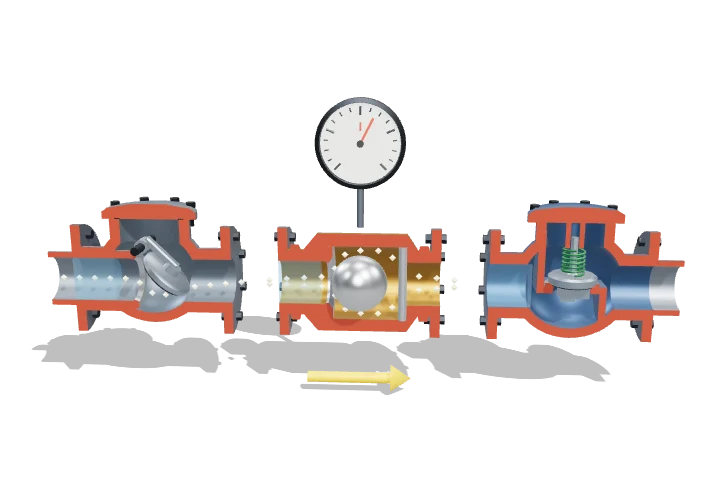 Open the interactive 3D model →
How does a pipe stop water flowing backwards when there is nobody there to shut a tap?
A check valve is a one-way door for liquids and gases. Pushing forward opens it; when the flow tries to go backwards, the backward push shuts it tight. It needs no motor and no person — the fluid does all the work.
A check valve is an automatic one-way valve: forward pressure lifts its closure off the seat once it exceeds the cracking pressure, and reverse pressure drives the closure back onto the seat. Swing, ball and spring-loaded lift designs trade pressure loss, closing speed, size and cost against one another.
Key facts
- Bore (this model)
- 32 mm (DN32-like), face-to-face ≈ 116 mm
- Cracking pressure, weight-closed (swing, ball)
- ≈ 0.5–5 kPa
- Cracking pressure, spring-loaded
- ≈ 3.5–35 kPa (0.5–5 psi) typical
- Loss coefficient K, swing check fully open
- ≈ 2
- Loss coefficient K, lift (globe-type) check
- ≈ 10–14
- Water-hammer surge, 1 m/s stopped
- ≈ 1–1.4 MPa (Joukowsky)
Parts you can explore (11)
- Swing check body
- Swing disc and hinge
- Ball check body
- Check ball
- Lift check body
- Lift disc and spring
- Valve seats
- Flanges and pipe stubs
- Pressure arrow
- Differential pressure gauge
- Flow tracers
In the 3D model
Rotate and take apart the model, follow a guided tour of what each part does and why it’s needed, change it with a live slider, and test yourself with a short quiz. Free, no sign-up.
OpenArc Models’ models are simplified teaching schematics. Terms · Privacy