Cells & molecules
Cell nucleus
Cell biology · Organelle
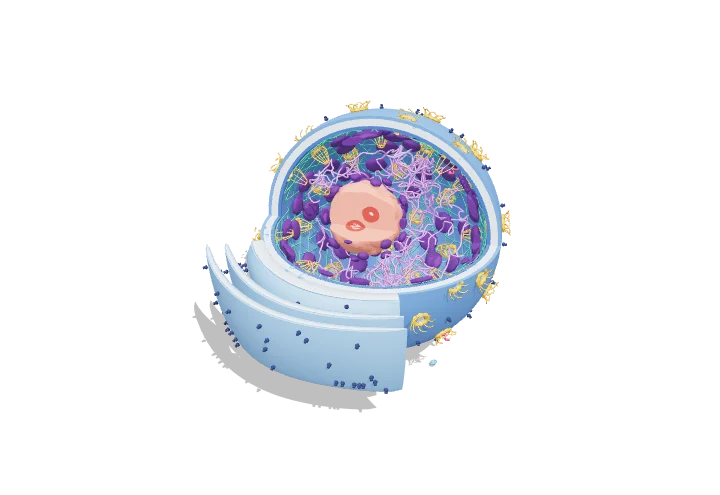 Open the interactive 3D model →
How do two metres of DNA fit in a ball ten times narrower than a hair — and stay readable?
The nucleus is the cell’s control room, where its DNA is stored. It is wrapped in a double membrane with thousands of guarded doorways called pores that decide what goes in and out. Inside, DNA that is in use is loosely unpacked, unused DNA is packed tight, and a dense spot called the nucleolus builds the cell’s protein-making machines.
The nucleus stores the genome behind a double membrane and controls which genes are read, while nuclear pore complexes gate all traffic between nucleus and cytoplasm. Inside, chromatin is organised into open and compact regions, and the nucleolus builds ribosomal subunits.
Key facts
- Diameter
- ≈ 5–10 µm in most animal cells
- Perinuclear space
- ≈ 30–50 nm wide
- Pore complexes per nucleus
- ≈ 2,000–4,000 (proliferating mammalian cell)
- NPC mass
- ≈ 110–120 MDa (vertebrate), ~30 nucleoporin types
- Passive-diffusion limit
- ≈ 30–60 kDa (soft cut-off)
- DNA per diploid human nucleus
- ≈ 6.4 × 10⁹ bp ≈ 2 m
Parts you can explore (14)
- Outer nuclear membrane
- Perinuclear space
- Inner nuclear membrane
- Nuclear pore complexes
- Nuclear lamina
- Heterochromatin
- Euchromatin
- Granular component
- Dense fibrillar component
- Fibrillar centres
- Nucleoplasm
- Rough ER
- Ribosomes
- Transport cargo
In the 3D model
Rotate and take apart the model, follow a guided tour of what each part does and why it’s needed, change it with a live slider, and test yourself with a short quiz. Free, no sign-up.
OpenArc Models’ models are simplified teaching schematics. Terms · Privacy